Title Conditions (Scotland) Act 2003 - Real Burdens
Introduction
The Title Conditions (Scotland) Act 2003 ("The Title Conditions Act") provides detailed rules for the creation and content of real burdens on and after the Appointed Day (28 November 2004). A real burden is an obligation on the owner of an area of land, either to do something in relation to that area of land, such as an obligation to erect a house, or an obligation not to do something such as an obligation not to use a house for business purposes.
Real burdens can be either "praedial" or "personal". Praedial real burdens are those enforceable by a person in their capacity as owner of other land whereas personal real burdens are those enforceable by certain bodies whose right to enforce does not depend on ownership of land.
Constitutive deeds
A constitutive deed is a deed which creates real burdens. Since the appointed day, any type of deed can be a constitutive deed, provided it meets the criteria set out in section 4 of the Title Conditions Act. In practice, however, real burdens are usually created in dispositions, deeds of conditions or deeds of real burdens.
Under the Land Registration etc (Scotland) Act 2012, it is now possible that a notice of title may contain real burdens. Any such instances should be referred to a senior caseworker.
Burdened and benefited properties
The term "burdened property" is used to describe subjects that have burdens imposed on them in favour of other subjects. In first registrations, the most common example of this will occur where the granter of the deed inducing registration imposes burdens on the subjects disponed in favour of the subjects retained by the granter in the Sasine Register. In transfers of part, the granter of the deed inducing registration will normally impose burdens on the subjects in the transfer of part in favour of the subjects in the parent title.
Benefited property example
In the example below, the owner of 10 Smith Street has sold off part of his garden ground and imposed a real burden restricting the use of that garden ground in favour of the subjects he is retaining. In other words, the granter has the right, as owner of 10 Smith Street, to enforce those real burdens against the owner of the garden ground disponed. In this example, the garden ground disponed would be the "burdened property" and the house 10 Smith Street, retained by the granter, would be the "benefited property”.
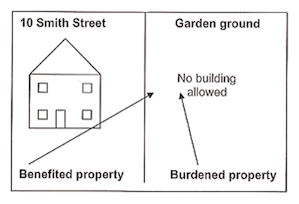
Subjects can be both burdened and benefited
It is fairly common for subjects to be both a burdened property and a benefited property. In the example below, the owner of 10 Smith Street has also agreed to impose a burden of maintenance of a boundary fence on the subjects retained by him in favour of the garden ground disponed. In other words, the garden ground disponed is a burdened property in respect of the real burdens imposed on it in favour of the retained subjects, but is also a benefited property in respect of the real burdens imposed on 10 Smith Street in favour of the garden ground. The proprietors of the garden ground are burdened by restrictions as to the use of the garden ground, but also have the benefit of being able to ensure that the proprietors of the house contribute to the maintenance of the boundary fences.
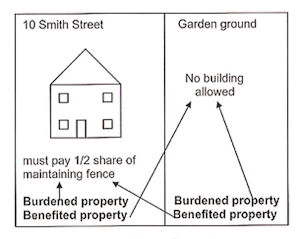
Rules for the Creation of Real Burdens
The rules for the creation of real burdens are set out in section 4 of the Title Conditions Act. It is essential that the deed complies with each of these rules, otherwise it fails to create real burdens. The rules are:
Rule 1: The deed must set out the terms of the real burden in full
Rule 2: The deed must be granted by the owner of the burdened property
Rule 3: The deed must use the term "real burden" or one of the nameable real burdens
(The nameable real burdens are: community, affirmative, negative, ancillary, facility and service burdens)
Rule 4: The deed must nominate and identify the burdened and benefited properties
Rule 5: The deed must be registered against the burdened and benefited properties
Deeds Unaffected by the Rules for the Creation of Real Burdens
The following types of deeds do not need to comply with the provisions of the Title Conditions Act as they do not create real burdens:
- Deeds registered in terms of the Town and Country Planning (Scotland) Acts, such as
- Tree Preservation Orders
- section 50/75 Agreements
- Leases (unless the deed creates real burdens affecting the landlord's interest). Although a tenant can be bound by real burdens affecting a landlord's title, a tenant's interest in a lease cannot be a burdened or benefited property in its own right.
- Deeds registered in terms of section 32 of the Enterprise and New Town (Scotland) Act 1990.
- Deeds that burden a property with a liferent interest sometimes describe this as a "real burden", however a liferent interest does not constitute a real burden.
Step by Step Guides to Determine Whether an Application Complies with the Rules for the Creation of Real Burdens
Procedures to Follow if There is a Failure to Comply with One or More of the Rules for the Creation of Real Burdens
Personal Real Burdens
(The personal real burdens are: conservation, rural housing, maritime, manager, economic, health care and climate change burdens)
Personal real burdens are burdens which are enforceable by certain bodies whose right to enforce does not depend on ownership of land. In terms of section 4(2)(c)(iii) of the Title Conditions Act, a deed that creates a personal real burden must nominate and identify the person in whose favour the real burden is constituted, who is known as the holder of the burden. As there is no benefited property, deeds creating personal real burdens do not need to be dual registered.
See also Discharge of personal real burdens below.
Section 53
General
Section 53 of the Title Conditions Act provides that, if a property forms part of a group of related properties that are affected by a common scheme of real burdens and a disposition of at least one of these properties was registered before the Appointed Day (28 November 2004), all the properties within the group have the right to enforce those burdens against each other.
Deeds that create real burdens in terms of section 53 do not need to satisfy two of the Rules for the Creation of Real Burdens set out above in terms of section 4 of the Act in that they:
- do not need to nominate a benefited property (the property that has the right to enforce the real burdens);
- do not need to be dual registered against the benefited property
They do, however, need to satisfy the other rules set out in section 4.
Dispositions by local authorities and housing associations form the majority of deeds that create real burdens in terms of s.53 as properties in these types of estates or developments are sold over a long period of time. In most cases, at least one property will have been sold before the Appointed Day.
It is not competent to create real burdens over a pro indiviso share in a property (section 4(6),Title Conditions Act). A number of housing associations operate shared ownership schemes whereby only a pro indiviso share in the property is sold and in some instances, the dispositions of the pro indiviso shares attempt to create real burdens. Any dispositions of a pro indiviso share only that contain real burdens should be referred to the registration officer's referral point.
Section 53 / section 4 "hybrid" deeds
Deeds that create real burdens in terms of section 53 sometimes also contain a nomination and identification of a benefited property in respect of some or all of the burdens. These other subjects are often described in the deed as "the adjoining subjects" or "the adjoining property".
Where the burdens are created solely in terms of section 53 this nomination of a benefited property is not necessary, but it does not prevent the burdens from being created in terms of that section. It is possible that the deed is merely narrating burdens that have been imposed on the adjoining subjects in the past, or that are intended to be imposed on them in the future.
However it is also possible that the deed is attempting to create some (or all) of the burdens in terms of section 4, in which case the deed must be dual registered contemporaneously against the other subjects in respect of those burdens.
Typically, the body of the deed will state that some or all of the real burdens are created in terms of section 53 of the Title Conditions (Scotland) Act 2003 ("the Act"), but the Schedule annexed to the deed will also contain a nomination of a benefited property in respect of some or all of those burdens, as in the example below:
In the above example, the real burdens in part II are created solely in terms of section 53 and there is therefore no nomination of a benefited property. In addition however the disposition nominates "the adjoining subjects" as the benefited property in respect of the real burdens in Part III, and Part IV sets out real burdens which are imposed on those adjoining subjects.
How such applications are dealt with depend on a number of factors. They should only be settled by registration officers who have completed the appropriate training and in accordance with the guidance set out below.
Registration Guidance
The procedure to be followed when registering such deeds depends on whether or not the deed has been presented for contemporaneous dual registration against the other subjects affected by the real burdens,
Deed presented for dual registration
If the application states that real burdens have been created in terms of section 53 and the deed:
- also contains a nomination and identification of a benefited property in respect of some of the real burdens created in the deed, and
- is dual registered contemporaneously against the other property affected by these burdens
the "hybrid" effect would be that, in addition to any real burdens created in terms of section 53, the real burdens that include nomination and identification of a benefited property would be created in terms of section 4 (provided that all the other requirements set out in section 4 have been met).
Such an application should be settled following the appropriate set of instructions for hybrid deeds in the section on Title sheet entries for deeds registered in terms of section 53 and for section 54/section 4 hybrid deeds below. For the avoidance of doubt, the application should only be settled by a registration officer who has completed the appropriate real burdens training.
Deed not presented for dual registration
If the application specifies that the real burdens have been created in terms of section 53, the application should be settled following the appropriate set of instructions for deeds registered in terms of section 53 set out in the section on Title Sheet entries for deeds registered in terms of section 53 and for section 53 / section 4 hybrid deeds.
However, if a deed which nominates a benefited property and/or includes real burdens imposed on other subjects has not been presented for dual registration and there is no indication within the application that section 53 of the Act applies, the following guidance applies:
If the other property is in the Sasine Register, a sasine application form is required for dual registration to proceed – since none has been submitted, reject the application as it does not comply with the requirements of section 120 of the Title Conditions Act.
If the other property is in the Land Register, no additional application form is required, but a fee for dual registration of the deed must be paid:
(a) If payment is by direct debit, we can deduct the dual registration fee and the required application can be created.
(b) If payment is by cheque, and there is no payment facility to create an application for dual registration, reject the application as it does not comply with the requirements of section 120 of the Title Conditions Act.
Deeds of Conditions
Introduction
The burdens created in deeds of conditions are normally community burdens. These are real burdens that are imposed under a common scheme on two or more units of property and are mutually enforceable in that each unit is both a burdened property and a benefited property in relation to those burdens (section 25 of the Title Conditions (Scotland) Act 2003) ("the Act").
Deeds of conditions, like all other deeds which create real burdens, must meet all the rules for the creation of real burdens set out in section 4 of the Title Conditions Act. However, the following points should be noted:
- Although the burdens created in deeds of conditions are usually community burdens, the deed does not need to call them this. It may simply refer to them as "real burdens";
With regard to the nomination and identification of burdened and benefited properties, a deed of conditions must nominate and identify the "community" of properties affected by the real burdens set out in the deed.
An example of satisfactory nomination and identification is as follows:
We Smith Holdings (Developments) Limited, Proprietors of the subjects hereinafter referred to as "the Development", hereby provide as follows:
In this deed:
"the Development" means ALL and Whole the subjects at Springfield, Balfour Street, Edinburgh, registered under Title Number MID12344
The following community burdens are imposed on the Development…
In most cases, a deed of conditions does not need to be dual registered. The deed is normally registered prior to any properties being sold and therefore at the time of registration the whole development is at the same time both burdened and benefited.
There are, however, some occasions where it is necessary for a deed of conditions to be dual registered. For example, the deed might nominate a property outwith the extent of the deed to be the benefited property with the right to enforce some or all of the burdens, or servitude rights may be reserved or granted in the deed that affect properties outwith the extent of the development. In these cases, the deed would need to be dual registered against these other properties.
Postponement of effectiveness of real burdens
It is possible for constitutive deeds registered after the Appointed Day to make express provision to postpone the effectiveness of real burdens (section 4(1) of the Title Conditions (Scotland) Act 2003). This allows developers flexibility, should they wish to depart from the deed of conditions at a later date. Also, while the burdens remain ineffective in respect of the parts of the development that are not yet sold, the burdens cannot be enforced against the developer by proprietors of units that have been sold. If a deed of conditions does not postpone the effectiveness of the real burdens, the burdens take immediate effect.
The effectiveness of the real burdens can be postponed to a date specified in the deed of conditions, or the date of registration of some other specified deed. There are no statutory styles for postponement or for making the burdens effective in the dispositions of the individual properties.
Servitude rights in Deeds of Conditions
It is possible for a deed of conditions to set out servitude rights affecting a development - see Servitudes and the instructions contained in the section on Title Sheet entries for Deeds of Conditions and sections 33 and 35 provisions below for further information.
Title Sheet Entries for Deeds that Create Real Burdens
Introduction
Section 9(1)(a) of the Land Registration etc (Scotland) Act 2012 (the 2012 Act) provides that the Keeper must enter in the burdens section of the title sheet the terms of real burdens affecting the subjects, and must also include a description of the benefited property (unless the burden is a personal real burden, in which case it must identify the name and designation of the person who has title to enforce it).
In terms of Section 6(1)(b) of the 2012 Act, the Keeper is required to enter in a title sheet "the particulars of any incorporeal pertinents (including, if there is a burdened property, the particulars of that property in so far as known)" i.e. the title or right to enforce a real burden and identify the burdened property in the entry.
The instructions below provide guidance on creating title sheet entries for deeds that create real burdens in terms of section 4 of the Title Conditions Act, where the deed that creates the real burdens is the deed inducing registration.
Real burdens created in a previously recorded/registered deed
If real burdens are created in a deed recorded or registered prior to/on the same day as the current application, there are several additional issues to consider - see Step by Step guides: Real Burdens Created in a Previously Recorded / Registered Deed. This type of casework should only be completed by registration officers who have completed the relevant training.
The only exceptions to this are applications affected only by real burdens created in Deeds of Conditions or applications registered in terms of Section 53, see sections above for additional information on such applications.
Burdens section entries and explanatory note
Preambles
The preamble should describe the burdens as "real burdens", to reflect the terminology of the Title Conditions Act. In the preamble, best practice is not to describe the subjects being registered as simply "the subjects in this Title", but to give a fuller description, such as "subjects 10 Smith Street, Aberdeen, being the subjects in this Title". This will make the settling of future applications more straightforward.
If the deed creates real burdens in favour of the subjects being registered but does not impose real burdens on these subjects, the preamble should read: …. "contains the following real burdens to which the proprietor of the subjects in this Title has subsisting rights". However, if the deed creates real burdens on the subjects disponed and also creates real burdens on the retained subjects, the preamble should read: …. "contains the following real burdens"
If the deed also creates servitude rights, the preamble should say: …."contains the following real burdens and servitudes".
Identification of benefited property
Section 9(1)(a) of the 2012 Act provides that the Keeper must enter in the burdens section of the title sheet the terms of real burdens affecting the subjects, and must also include a description of the benefited property (unless the burden is a personal real burden, in which case it must identify the name and designation of the body that has title to enforce it).
Since the introduction of the Title Conditions Act, the majority of deeds that create real burdens set the burdens and servitudes etc out in a schedule where, for example, "Part 1" might be definitions, "Part 2" might be real burdens affecting the subjects, "Part 3" might be servitudes affecting the subjects etc. The easiest and most accurate way of editing such deeds is to include the schedule as it appears in the deed, only making such editing changes as are strictly necessary, as shown in the example below. Setting the entry out in this way ensures that the deed is accurately reflected and that the benefited property is clearly identified.
If a deed is not set out in schedule format, the benefited property must be clearly identified in the text of the entry, as in the following example:
Declarations in terms of section 90
Declarations that there shall be no applications to the Lands Tribunal under section 90 of the Act should be included in the burdens section entry. Burdens and servitudes can be varied or discharged by the Lands Tribunal, if an application is made to them under section 90 of the Act. Section 92 of the Act, however, allows for constitutive deeds to provide that no such application can be made for a period of up to 5 years.
Burdens section: explanatory note (Part 1 Real Burdens)
When a constitutive deed is registered, the title sheet entry/entries will reflect the description of the burdened and benefited properties contained in that deed. However, in time, changes may take place which will mean that the description of one or both of these properties is no longer accurate. One such change would be where a benefited or burdened property is subdivided.
In order to make it clear that the description of the burdened and benefited properties is only correct as at the date of registration of the constitutive deed, the following note should be added at the end of the burdens section of any new Title Sheet that is being created.
Explanatory Note: The descriptions of the burdened and benefited properties in any deed registered in terms of sections 4 and 75 of the Title Conditions (Scotland) Act 2003 in this Title Sheet are correct as at the stated date of registration of such deed.
Property section entries and explanatory note
In terms of Section 6(1)(b) of the 2012 Act, the Keeper is required to enter in a title sheet "the particulars of any incorporeal pertinents (including, if there is a burdened property, the particulars of that property in so far as known)" i.e. the title or right to enforce a real burden and identify the burdened property in the entry.
If a property is a benefited property in relation to real burdens created in a constitutive deed or is both burdened and benefited by the real burdens, the right to enforce the real burdens is included in the property section. This information is added in the form of a Schedule of Real Burdens that identifies the deed that created the real burdens and describes the burdened and benefited property or properties.
Property section explanatory note
When a constitutive deed is registered, the title sheet entry/entries will reflect the description of the burdened and benefited properties contained in that deed. However, in time, changes may take place which will mean that the description of one or both of these properties is no longer accurate. One such change would be where a benefited or burdened property is subdivided.
In order to make it clear that the description of the burdened and benefited properties is only correct as at the date of registration of the constitutive deed, a note in the style below should be added to the property section of the title sheet.
Note: The description of the burdened property in each entry of the Schedule of Particulars relative to Subsisting Rights to Real Burdens above should be read in conjunction with the Explanatory Note in the Burdens Section.
Burdens section entry: benefited and burdened property title sheet and benefited property title sheet
In addition to the property section entry, an entry for the deed should be made in the burdens section of the benefited property title sheet, and the burdens that can be enforced should be set out at length. If the deed creates real burdens in favour of the subjects being registered but does not impose real burdens on these subjects, the preamble to the burdens section entry should read "contains the following real burdens to which the proprietor of the subjects in this title has subsisting rights".
However, if the deed creates real burdens on the subjects disponed and also creates real burdens on the retained subjects,the preamble should read: "contains the following real burdens".
Title sheet entries: practical instructions
If real burdens are created in the deed inducing registration, three possible situations apply: the subjects being registered are burdened by the real burdens created in the deed, the subjects are benefited by the real burdens created in the deed (ie they have the right to enforce real burdens created in the deed over other subjects), or the subjects are both burdened and benefited by the burdens created in the deed. Instructions for dealing with each of these situations can be found by clicking on the relevant link below.
Title sheet entries for deeds registered in terms of section 53 and for section 53 / section 4 hybrid deeds
Title Sheet entries for Deeds of Conditions and sections 33 and 35 provisions
Deeds of conditions
Servitudes in deeds of conditions
For title sheet entries for servitudes set out in deeds of conditions - see Servitudes.
Provisions of sections 33 and 35 of the Title Conditions Act
In terms of section 33(1)(a) of the Title Conditions Act, a deed which creates community burdens can make provisions that the owners of specific units can grant a discharge of those burdens. Any provisions made in terms of section 33(1)(a) of the Act should be included in the burdens section entry for a deed of conditions. Section 35 of the Act provides a method whereby community burdens can be discharged by the proprietors of adjacent properties to a burdened property.
However, in terms of section 35(1)(b) of the Act, the deed that creates the community burdens can disapply section 35 of the Act. Any disapplication of section 35 of the Act should be included in the burdens section entry.
Real Burdens Created in a Previously Registered / Recorded Deed
It is possible that the subjects being registered may be affected by real burdens created in a deed recorded or registered since the Appointed Day (28 November 2004), but prior to (or on the same day as) the current application. Typically, in such cases a previously dual registered deed will have created real burdens and nominated subjects retained by the granter as the benefited property in respect of those real burdens. It is also possible that the deed might have created reciprocal burdens and that the retained subjects might be both burdened and benefited, or (unusually) that the retained property is the property burdened by the real burdens.
This section provides guidance on the additional issues that must be considered when registering subsequent FR or TP applications affecting those retained subjects.
The following instructions do not apply to applications affected by real burdens created in previously registered deeds of conditions. If an application is affected by a previously registered deed of conditions the instructions in Deeds of Conditions above should be followed.
Having established that there is a prior deed creating real burdens that affects the subjects being registered, there are several issues which must be considered before making title sheet entries for this deed. If the subjects being registered form part of the benefited property or the burdened property in the previously registered deed, separate considerations apply in respect of each of these. These are set out below.
Subdivision of a Benefited Property
Section 12 of the Title Conditions (Scotland) Act 2003 ("the Act") provides that where part of a benefited property is conveyed, that part ceases to be a benefited property unless the disposition makes some other provision.
The disposition can provide that the part retained and the part conveyed are each to be benefited properties or that the part retained will cease to be a benefited property. Different provisions may be made in respect of different real burdens, so it is possible that a disposition might convey the sole right to enforce certain burdens but state that, in respect of other burdens, the part sold and the part retained will both continue to be benefited.
In respect of rights of pre-emption or any other options to acquire the burdened property, the provisions that can be made are restricted by section 12(3)(c) of the Act in that there can only ever be one benefited property.
Any provision in terms of section 12 of the Act must:
specifically identify the deed that created the real burdens
state the date of recording or registration and
identify the real burdens in respect of which the provision is being made.
The requirement that the deed constituting the real burdens should be identified by its date of registration or recording can be considered to be fulfilled if the provision clearly refers to the entry number of the deed in a burdens section of a title sheet. For the avoidance of doubt, if the provision simply refers to the real burdens or real burdens deeds in a title sheet without specifying the particular entry number then that is not sufficient - the provision must identify the specific deed. If the provision in terms of section12 does not meet the above requirements then the application should be rejected.
Section 12 of the Act does not apply to community burdens. These are burdens that are imposed under a common scheme on two or more units where each of these units is, in relation to some or all of the burdens, both a burdened property and a benefited property. Community burdens are typically created in deeds of conditions.
Subdivision of a benefited property: title sheet entries
If a DIR includes a statement that the subjects being registered are to be a benefited property in respect of real burdens created in a previously registered deed, the statement should be included in the entry for the DIR in the burdens section of the subjects being registered.
Multiple or individually identified benefited properties
It is possible that a previously dual registered deed might identify several different benefited properties by their postal address or plot number, as in the following example:
"the benefited subjects" means the subjects 10 John Street, 12 John Street and 14 John Street, described in Disposition to Wacława Nowakowska, recorded G.R.S. (Renfrew) 25 Jan. 1996".
In this example, the subjects 10, 12 and 14 John Street have each been separately nominated as a benefited property. In other words, there are three separate benefited properties in respect of the real burdens. This means that a subsequent disposition of 10, 12 or 14 John Street individually would not constitute the subdivision of a benefited property in terms of section 12 of the Act but would instead be a disposition of one of the benefited properties. In terms of section 12 of the Act, it would therefore not be necessary for the deed to make any provision in respect of enforcement rights as these rights would be automatically transferred. However, when dealing with a first registration, reference to this deed should be made in the application form or elsewhere in the application to alert the Keeper to its existence.
Transfer of the residue of a benefited property
A disposition of the last part of a benefited property does not constitute a subdivision of the benefited property, but rather a transfer of the remainder. The disposition of the last part therefore does not need to make provision in terms of section 12 of the Act - the rights of enforcement transfer automatically. However, when dealing with a first registration, as you will not be examining the Sasine Register, reference to this deed being a disposition of the remainder would require to be made in the application form or otherwise within the application to alert the Keeper to its existence.
Applications submitted on the same day
If two or more FR or TP applications which nominate the sasine major area or parent title as a benefited property are submitted for registration on the same day, these should be referred to a senior caseworker for advice.
Subdivision of a Burdened Property
Section 13 of the Title Conditions (Scotland) Act 2003 provides that where part of a burdened property is sold, the part sold and the part retained shall both separately constitute burdened properties. This means that a disposition of part of a burdened property does not need to make any provision regarding previously created real burdens as the burdens will automatically apply.
The only exception to this rule is that if the real burden cannot affect the part sold, the part ceases to be a burdened property.
The general rules are that in transfers of part, real burdens imposed on the parent title by a previously dual registered deed will be entered in the burdens section of the TP regardless of whether or not the DIR refers to the prior deed for burdens.The omission of the burdens in a previously recorded/registered constitutive deed should only be considered if it is clear that none of the real burdens created by the previous deed can affect the part sold. Great care should be taken before deciding to omit such a deed. If there is any doubt as to whether any of the real burdens might affect the part sold, the real burdens should be entered in their entirety.
For first registrations, reference to to prior deeds containing real burdens would require to be made in the application form or otherwise within the application to alert the Keeper as to their existence. Unless otherwise indicated within the application, or it is clear from examination of the deeds that the real burdens cannot affect your subjects, the real burdens should be entered in their entirety. Again, great care should be taken before deciding to omit any prior real burdens.
Applications submitted on the same day
If two or more FR or TP applications which impose burdens on the sasine major area or parent title are submitted for registration on the same day, these should be referred to a senior caseworker for advice.
Descriptions of burdened/benefited properties in title sheets: Explanatory notes (Part 2 Real Burdens)
When a constitutive deed is registered, the title sheet entry/entries will reflect the description of the burdened and benefited properties contained in that deed. However, in time, changes may take place which mean that the description of one or both of these properties is no longer accurate. One such change would be where a benefited or burdened property is subdivided.
In order to make it clear that the description of the burdened and benefited properties is correct only as at the date of registration of the constitutive deed, a note in the style below should be added to the burdens section (and property section, if appropriate) of any new Title Sheet that is being created. Guidance on when it is appropriate to add these notes is included in the Step by step instructions for FRs and TPs affected by a previously registered deed that creates real burdens set out below. For the avoidance of doubt, no attempt should be made to add these notes to the title sheet of the other property affected by real burdens created in a previously registered constitutive deed.
Step by Step guides: Real Burdens Created in a Previously Recorded / Registered Deed
Guidance on completing applications where the subjects are affected by real burdens created in a previously registered deed are set out in the links below.
First registration step by step guides
In order to establish which of the guides is appropriate, the following question should first be considered:
What is the relationship of the FR subjects now being registered to the burdened/benefited properties in the previously registered deed?
The description of the subjects in the DIR of the FR now being registered should be compared with the description of the burdened and benefited properties in the previously registered deed. If the deed which created the real burdens was registered in the Land Register, the burdens section entry of the relevant title sheet should be examined to identify the burdened and benefited properties in respect of the real burdens created in the deed. Using this information, establish which of the following Step by Step guides is appropriate.
In the Step by Step guides, where any reference is to be made to title numbers in the property section schedule and/or burdens section entries in respect of properties that have rights to shared plots, only the sharing plot title number should be entered.
Transfer of part step by step guides
In order to establish which of the guides is appropriate, the following question should first be considered:
What is the relationship of the TP subjects now being registered to the burdened/benefited properties in the previously registered deed?
Examine the burdens section entry/entries for all deeds registered after 28 November 2004 in the parent title sheet to identify the burdened and benefited properties in respect of the real burdens created in the deed(s). (All applications must be settled in order of date of registration.) Using this information, establish which of the following step by step guides is appropriate.
In the following step by step guides, where any reference is required to be made to title numbers in the property section schedule and/or burdens section entries in respect of properties that have shared plots, only the sharing plot title number should be entered.
Preservation of Real Burdens - Section 50 Notices
Notices of Preservation
Prior to the Appointed Day, the law did not require that a deed creating real burdens must specifically nominate a benefited property and deeds often created burdens without being clear about who had the right to enforce them. In certain circumstances, however, it was considered that enforcement rights were implied under common law. One of these circumstances was where real burdens were created in a Disposition where land was subdivided. In this situation, the rule was that if part of the land was disponed and another part retained, the retained land was deemed to have right to enforce the burdens. The rule in this situation was set out initially in the case of J A Mactaggart & Co v Harrower ((1906) 8F. 1101), and is sometimes known as "the Mactaggart rule".
In terms of section 49 of the Title Conditions Act this rule ceased to have effect on 28 November 2014 and after that date real burdens which could only be enforced by virtue of this rule were no longer be enforceable.
However, in terms of section 50, the owner of land which was a benefited property by implication by virtue of the Mactaggart rule could register a Notice of Preservation within a 10 year period from 28 November 2004 to 28 November 2014. If a Notice was registered within that time period, the benefited property will continue to be benefited.
Registration officers who settle TP and DW applications are most likely to encounter Notices of Preservation submitted as DW applications.
Registration officers who settle First Registration applications are more likely to encounter a Notice of Preservation that has previously been recorded in the Sasine Register against the subjects now being registered.
Any application to register a Notice of Preservation, or any application affected by a prior Notice of Preservation, should be settled only by Legal Settlers who have completed training on deeds that create real burdens.
A Notice of Preservation will
- include the name and address of the person sending the Notice
- identify the burdened property and the benefited property
- set out the terms of the real burden(s)
- include an explanation of why the property described as the benefited property is benefited
- include details of the service of the Notice
- be signed by the person sending the Notice before a Notary Public.
- be registered contemporaneously against the burdened and benefited
properties specified in the Notice.
Title Sheet entries for Notices of Preservation
Discharge of Real Burdens
Discharge of Real Burdens by Owner of Benefited Property
Introduction
If real burdens were created after 28 Nov. 2004 by registration against both the burdened and the benefited properties, the position regarding enforcement rights is relatively clear as the deed which created the real burdens will have nominated and identified a benefited property.
In terms of section 15 of the Title Conditions Act, a real burden is discharged as respects a benefited property by registering against the burdened property a deed of discharge granted by or on behalf of the owner of the benefited property.
If real burdens being discharged were created after 28 Nov. 2004, and the real burdens in a deed are wholly discharged, the benefited property title sheet becomes inaccurate insofar as continuing to include a schedule of enforcement rights in respect of those burdens. Consequently, if there is no application to register the deed against the benefited property, that title sheet will require to be rectified.
A deed which discharges real burdens can either wholly discharge the right of the owner of the benefited property to the burden or discharge it to a limited extent, as specified in the deed. For example, a prohibition on external alterations might be discharged to the extent of allowing a
conservatory (such deeds are commonly called Deeds of Variation).
A deed which discharges real burdens is effective only in respect of the benefited property whose owner has granted it. The enforcement rights of the owners of any other benefited properties are unaffected
If it is clear that the granter of the discharge is the owner of the only benefited property, the real burdens can safely be removed from the burdens section of the burdened property title sheet and there is no need to add an entry for the discharge to the burdens section. However, if editing the entry to remove the discharged burdens would be too complex or time consuming the text can be left unaltered and a note in the following style should be added to the entry:
"Note: The real burdens in the foregoing disposition are affected by the discharge of real burdens/minute of waiver in Entry 2."
In this situation, a new entry for the discharge should be added to the burdens section in the following style:
"Discharge/Minute of Waiver by A, proprietor of xxx, registered (date), modifies the real burdens in the disposition in Entry 1 as follows: ..."
The wording of the preamble should reflect the deed as closely as possible.
If the discharge does not wholly discharge the real burden but only limits its extent, the entry should reflect the wording of the deed as closely as possible.
Title Sheet Entries: Benefited Property Title Sheet
No application to register the discharge against the benefited property
If a deed which discharges real burdens is registered against the burdened property only, section 105 of the Title Conditions (Scotland) Act 2003 requires the Keeper to alter the benefited property title sheet to take account of the terms of the discharge, as considered necessary. Where the real burden being discharged was created by dual registration in a deed registered after 28 Nov. 2004 by dual registration, the benefited property title sheet should be amended.
If there is no pending application against the benefited property, a title update (TU) application should be created. If the real burdens specified in the schedule of real burdens have been discharged in their entirety in respect of every burdened property, the phrase "together with the subsisting rights to real burdens specified in the schedule below" and the schedule of real burdens should be deleted from the property section. However, if only some of the real burdens in the deed have been discharged, or if the real burdens have not been discharged in respect of every burdened property, the property section should be left unaltered.
In the burdens section, if all burdens in the deed have been discharged in respect of every burdened property the burdens section entry can be deleted. However, if the deed also contains real burdens and/or servitudes which still affect the subjects, the text should be amended to remove the real burdens which have been discharged, where possible.
However, if editing the entry to remove the discharged burdens would be too complex or time consuming the text can be left unaltered and a note in the following style should be added to the entry:
"Note: The real burdens in the foregoing disposition are affected by the discharge of real burdens/minute of waiver in Entry 2."
In this situation, a new entry for the discharge should be added to the burdens section in the following style:
"Discharge/minute of waiver by A, proprietor of the subjects in this title, registered (date), modifies the real burdens in the disposition in Entry 1 as follows: ..."
The wording of the preamble and the text of the entry should reflect the wording of the deed as closely as possible.
Benefited property is sasine register
If the benefited proprietor's interest is not registered, a search sheet for their interest should be traced and a note in the following form added to it.
"Discharge of burden/Minute of waiver' registered (date) affects subjects [postal address] in (Title Number)."
Application made to register the discharge against both the burdened and the benefited property
If an application to register the discharge against both the burdened and benefited properties has been submitted, both the property and burdens sections of the benefited property title sheet must be amended..
If the real burdens specified in the schedule of real burdens have been discharged in their entirety in respect of every burdened property the phrase "together with the subsisting rights to real burdens specified in the schedule below" and the schedule of real burdens should be deleted from the property section. However, if only some of the real burdens in the deed have been discharged, or if the real burdens have not been discharged in respect of every burdened property, the property section should be left unaltered.
In the burdens section, if all burdens in the deed have been discharged in respect of every burdened property the existing burdens section entry can be deleted. If the deed also contains real burdens and/or servitudes which still affect the subjects, or if the burdens are still enforceable against other burdened properties, the text should be amended to remove the real burdens which have been discharged, where possible.
However, if editing the entry to remove the discharged burdens would be too complex or time consuming the text can be left unaltered and a note in the following style should be added to the entry:
"Note: The real burdens in the foregoing disposition are affected by the discharge of real burdens/minute of waiver in Entry 2."
In this situation, a new entry for the discharge should be added to the burdens section in the following style:
"Discharge/minute of waiver by A, proprietor of the subjects in this title, registered (date), modifies the real burdens in the disposition in Entry 1 as follows: ..."
The wording of the preamble should reflect the wording of the deed as closely as possible.
Discharge of Personal Real Burdens
In addition to the types of personal real burdens listed in the section above above, certain feudal real burdens previously enforceable by a superior could be converted into personal real burdens, but only if the superior recorded a notice against the burdened property prior to the Appointed Day (28 Nov. 2004) in terms of the undernoted sections of the Abolition of Feudal Tenure etc (Scotland) 2000
The following guidance should be followed when registering deeds by the holder of a personal real burden which discharges their right to enforce that burden.
The following is guidance should be followed when creating title sheet entries for deeds by the holder of a personal real burden which discharge their right to enforce that burden.
In terms of sections 20 to 24 of the Title Conditions Act 2003 a real burden created in a deed recorded at least one hundred years ago can be extinguished wholly or partly by registering a Notice of Termination against the burdened property. See Notice of Termination of Burdens for further information.
Guidance on the discharge or variation of burdens created prior to 28 Nov. 2004 can be found here.
Registers of Scotland (RoS) seeks to ensure that the information published in the 2012 Act Registration Manual is up to date and accurate but it may be amended from time to time.
The Manual is an internal document intended for RoS staff only. The information in the Manual does not constitute legal or professional advice and RoS cannot accept any liability for actions arising from its use.
Using this website requires you to accept cookies. More information on cookies.
Feedback