Leases
- Admin4
- Admin
General
A contract of lease (or tack, as it was often called in the past) is one whereby the use of heritable subjects is given to a lessee (or tenant) in return for the annual payment of a rent (or tack-duty). The lessee has the use of the property subject to the conditions laid down by the granter of the lease (known as the lessor or the landlord). The lease is subject to an annual payment and is only for a definite number of years, after which the subjects revert to the landlord.
The Land Registration etc. (Scotland) Act 2012 (the 2012 Act) introduces significant changes to the process of registration in relation to leasehold titles. Any grant of lease or assignation of a leasehold interest requires the underlying plot of ground (the owner's right) to also be registered, unless, in the case of an assignation of a lease, the tenant's title was registered prior to 8 December 2014. Accordingly, an application to register an assignation submitted as a DW application against an existing leasehold title can be processed as normal, as can the grant of a head lease as a TP from a title of ownership. Conversely, the grant of a sub-lease from an existing leasehold title will require investigation to ascertain whether the owner's title is already registered, and an application relating to a leasehold interest submitted as a first registration application (whether the grant of a new lease or assignation of an existing lease) will require consideration to be given to the requirements for registration of the plot of ground.
As stated above, the grant of a lease from an existing ownership title is processed as a TP. Also, if a plot of land is registered then all subsidiary real rights are also deemed registered; this means that where the owner's title is registered then any transaction on an existing unregistered leasehold interest (including sub-lease interests) affects the registered plot of land and the deed must quote the title number of that plot. In practical terms registration of this deed will require the creation of a leasehold title sheet.
Automatic Plot Registration
Sections 24 and 25 of the 2012 Act make provision for first registration of a plot of land where the registrable deed relates to another right in that land. 'Automatic plot registration' ("APR") is the phrase used within RoS to describe the process.
Automatic plot registration is a process whereby a deed creating, transferring or otherwise affecting a subordinate real right (that is a real right other than ownership) induces first registration of the plot of land to which the deed relates. The key examples, effective from the designated day of 8 December 2014, are
- a grant of a long lease (including a lease of shooting or fishing rights) including a sub-lease or
- the assignation of an unregistered long lease or unregistered long sublease.
In those cases, and more rarely in the case of a notice of title affecting a lease, provided that the plot of land (the owner's title) affected by the lease/sub-lease is not already registered in the Land Register, an application for registration of the grant or assignation will induce registration of the plot of land to which the lease/sub-lease relates. The owner's consent is not required for registration to occur; rather the provisions of the 2012 Act place the Keeper under a duty to register the plot of land (to the same extent as the subjects of the lease) when processing an application relating to a transaction with the right of the tenant.
A deed of variation that extends the extent of the subjects let will induce APR of the plot of land, so far as not already registered. The plot of land to be registered when APR is triggered in these circumstances will comprise the original leased subjects plus the additional subjects. This is because the combined geographical area is now the “subjects of the lease” in terms of section 25(5)(a) of the 2012 Act.
Assignations and transactions affecting registered leases do not generally result in APR. However, a grant of a sub-lease or a notice of title for a registered head lease induces APR if the plot of land (the owner's title) is not registered.
The provisions for APR do not apply where the registrable deed is an assignation of a registered lease or any other dealing relating to a registered lease which (1) does not alter the extent to include a plot where the landlord's title is unregistered and (2) is not a sub-lease or notice of title affecting that lease.
Transactions affecting registered leases
Registration officers should bear in mind that once the plot of land is registered, i.e. the owner's title is registered, even where the title sheet for the plot of land does not disclose the existence of an existing long lease, the lease is deemed to be registered and transactions affecting such leases are considered to be transactions with "registered" leases.
Normally however, a registered lease will have its own title sheet and in many cases for leases registered prior to the designated day, a transaction affecting the lease occurring after the designated day will not induce APR.
A registration officer considering whether any particular type of transaction might induce APR should note that Sch. 4 of the 2012 Act was amended in this regard by the addition of paragraph 11B. The Land Registration etc. (Scotland) Act 2012 (Incidental, Consequential and Transitional) Order 2014 and The Land Registration etc (Scotland) Act 2012 (Amendment and Transitional) Order 2014 both contain relevant amendments to Sch. 4.
Where Automatic Plot Registration is Required
From the designated day, section 24 of the 2012 Act requires the Keeper to use APR to register the plot of land. In four cases the applicant must submit the deed inducing registration to the Land Register, but in one case, the registrable deed may continue to be submitted to the Register of Sasines until the Register is closed by an order of Scottish Ministers to the particular deed type or to all deeds.
- grant of a long lease (section 24(2));
- assignation or partial assignation of an unregistered lease by section 24(3);
- sublease granted by a tenant by section 24(4) (whether the head lease is registered or not);
- standard security over a subordinate real right (e.g. a standard security over a recorded standard security or a standard security over an unregistered lease (by s24(7)).
In all cases, APR is required where the owner's title to the plot is not registered. This includes leases such as shooting and fishing leases.
In terms of section 48(1) and (5), an application to record a disposition, a lease (including sub-lease), an assignation of lease (including sub-lease), or a standard security in the Register of Sasines must be rejected. The recording of such deeds in the Register of Sasines is of no effect.
In the case of a standard security over an unregistered plot, the applicant must submit the deed to the Land Register. However, this type of application does not induce APR, for the reasons set out below at Use of APR as closure of Register of Sasines progresses.
- notice of title to a subordinate real right, e.g. a notice of title by the creditor in a standard security (by s24(6)).
Section 48(1) and (5) provides that the recording of this type of deed continues to be effective and does not currently require that applications to record such deeds in the Register of Sasines be rejected. It is the grantee's choice whether to submit their application to register the deed in the Land Register under section 24.
Pro indiviso shares
If the lease affects a plot of land that is already registered in the Land Register but only to the extent of some pro indiviso shares or rights in common, with the remaining shares in ownership still in the Sasine Register, the applications should be referred to a senior caseworker for further guidance.
Use of APR as closure of Register of Sasines progresses
Section 48(3) allows for the Register of Sasines to be closed to deeds other than standard securities, by order or orders of the Scottish Ministers. Once an order is made under section 48(3), APR will be used to create a title sheet for the plot of land affected by the registrable deed under section 24(5).
An order has been made under section 48(2) to close the Register of Sasines to standard securities - see Voluntary Registration as a Result of the Closure of the Sasine Register to Standard Securities for more information. However, section 24(5) applies only to orders made under section 48(3), and consequently APR does not apply to standard security applications, other than standard securities over subordinate real rights, which induce APR by virtue of section 24(7). Instead, where the standard security is over an unregistered plot of land, the owner must apply for voluntary registration of the plot in order to register the standard security.
APR Scenarios
APR - Lease Scenarios and Outcomes
APR - Variation and/or Extension of Lease Scenarios and Outcomes
Examples of scenarios where a variation of lease incorporating additional subjects may be submitted, and the registration outcomes in terms of the 2012 Act.
Examples of scenarios where the extent of the leasehold subjects is not increased - showing Fees and whether APR is triggered.
Automatic Plot Registration - Intake Guidance
General
This guidance is concerned with the creation of applications on the LRS system on receipt of an Automatic Plot Registration (APR) application.
Most APR applications will be for a grant of lease or an assignation of lease. In such cases, an APR application will require the creation of one cadastral unit on the cadastral map, but two title sheets: one title sheet for the plot and one title sheet which is known as a lease title sheet.
Once completed, the two title sheets, and associated mapping information, will be available via email notifications to the relevant parties. (There is no second registration fee for the creation of the plot title sheet.)
The intake officer should create the applications in accordance with the guidance below.
For more general information, see Automatic Plot Registration above.
If a grant of lease is submitted for registration with an FR form it is likely the application should have induced registration of the plot; accordingly the application should be referred for further guidance.
Application submitted with FR form instead of APR form
Where a deed that triggers APR is submitted with an FR application form, it will not result in an automatic rejection. Application for Registration - Part B breaks down the form as to which Part B questions are mandatory for an APR application. The decision to accept an FR application form comes down to whether the questions required in an APR application are attempted or not, and then, how they are answered is key to whether we have enough information to create the AP application.
It is common for the questions on the FR form to be answered in relation to the deed which triggers APR i.e. the lease, assignation of lease or sub-lease, instead of being answered in relation to the plot. In such instances, the application should be rejected.
Where the questions on the FR form have been answered in relation to the plot, the application can be accepted.
Categorisation
The applications should be categorised as Category 3. Once the applications are confirmed in LRS they should be released as normal to the next LRS location.
| Useful Links |
|---|
| Application Form Check |
Automatic Plot Registration - Closing Notes
General
Receipt of an application to register a lease interest where the plot of land is not already registered will result in the creation of two title sheets, one for the plot of land and one for the lease interest. In all cases the registration date for the leasehold title will be the same as that for the plot of land, even if created subsequent to the plot title sheet (N.B. this is not a backdating action as the interest is in the Land Register as at the date of registration of the plot. However, authorisation to change the date of registration must still be obtained to ensure that this is only undertaken in the appropriate circumstances).
Closing notes
Two title sheets
Title Sheets should have been created for both the plot of land and the leasehold interest and closing notes should be added to the relevant search sheet for each interest. If the DIR is a grant of a new lease, a closing note should be added to the search sheet for the landlord's interest: this should refer to the title numbers for the two title sheets that have been created.
Pre search sheet title
If the owner's interest is untraceable from the information provided (e.g. lease was granted for 999 years in early 19th century) the closing note should be added to the search sheet relating to the lease, e.g.:
The plot of land subject to the [lease/assignation of 23 High Street, Newtown] is registered in terms of s.24 of Land Registration (Scotland) Act 2012 - To [TITLE NO.]
Style of Closing Notes
Useful links | |
|---|---|
| Styles of Closing Notes |
Examination of Applications Relating to a Lease
General
The essentials of a lease are:
- it must relate to immoveable/heritable subjects
- there must be a rent (though this can be illusory or nominal)
- there must be a term.
Only certain grants of lease, (or assignations of those leases), known as "long leases" can be registered in the Land Register. These are leases with a particular term.
A registration officer dealing with an application for registration of a grant of lease or assignation of lease (presented either as an APR application or as a TP of a registered plot (the owner's title) needs to assess whether the lease in question being granted or assigned is a "registrable" lease in the sense that it both meets the essentials of a lease and is a long lease.
An application for registration of a short lease or an assignation of a short lease should be rejected.
What is a 'registrable' lease?
The registration of a grant of a long lease or an assignation of a long lease, is authorised by section 1 of the Registration of Leases (Scotland) Act 1857 (the "1857 Act"), as amended by the 2012 Act, and section 17 of the 1857 Act as amended by the Land Tenure Reform (Scotland) Act 1974. Essentially, a probative lease of lands and heritages in Scotland can be registered in the Land Register provided that:
- the term exceeds 20 years (i.e. it must be for at least 20 years and a day) or
- if it is for a shorter period, it must be capable of being renewed at the grantee's request without subsequent agreement of the granter, so that its total duration exceeds 20 years or
- it is for a shorter period and the term has been extended by deed of variation so that the varied duration exceeds 20 years.
In most cases the term will be contained within the body of the deed. However, if the term refers to a head lease (or other) with regard to the start or end date of the new lease, but the term of that head lease is not expressly stated in the new lease, or it is not clear from the title sheet for the head lease what the actual term is, the deed should be rejected, - unless the presenting agent has confirmed within the application that the term of the new lease being registered exceeds 20 years or meets one of the other two criteria noted above. The presenting agent's certification on the application form is sufficient to allow the application to proceed. Any queries should be referred to a referral officer.
Assignations of such leases are also registrable in terms of said section 1, including where there is less than 20 years remaining of the term. Information about the calculation of the term and whether a lease is a long lease can be found below at Calculation of Term of Lease.
Section 2 of the 1857 Act provides that the effect of registration of a grant of lease where the lease is valid and binding in a question with the granters of it is, once registered, effectual against any singular successor in the lands and heritages let whose title is completed after the date of registration of the lease.
What does the registration officer require to check?
Grant of Lease/Assignation
Examination of landlord's Title
In general terms, the Keeper relies on the information provided in an application and the answer given on the application form regarding certification of links in title.However a grant of lease is a deed which must, in order to be valid (and consequently meet the condition of registration that the registrable deed must be valid), be granted by the registered or recorded proprietor (however an assignation of a long lease can be granted by an unregistered or unrecorded tenant).When an application for registration is for a lease by a party who has not completed their title to the subjects, and an advance notice does not provide a reason why registration should proceed, the application falls to be rejected - see rejection policy and procedures.Term
Rental
A rental must be stipulated in a lease (but it may be illusory) in order for it to meet the essentials for a lease. The rent need not be in money, but may be in produce or services.Authentication - probativity
Normally a formal deed is required for a grant of lease (the 1857 Act does not have a statutory style of lease). There is a statutory style of assignation of lease. It is a condition of registration in any event that the execution of the lease or assignation should be self-evidencing. Properly authenticated and stamped missives of let are an acceptable alternative, provided they are executed by the parties themselves in self-proving form and fulfill all the other requirements for a registrable lease.
If the registrable deed submitted is a set of missives of let, the application should be referred to a senior caseworker for consideration.
Requirement that lease be of 'lands and heritages'
Types of Long Leases
Lease granted/delivered prior to operational date for county - positive prescription for leasehold interests
It is for the applicant to satisfy themselves as to the validity of title, accordingly the following matters relating to prescription are for information purposes if required.
Section 1 of the Prescription and Limitation (Scotland) Act 1973 (‘the Prescription Act’) applies to any interest in land (including long leases), the title to which can competently be recorded, or which is registrable in the Land Register, and enacts that where possession of that interest was founded on and follows the recording in the Sasine Register of a deed constituting a title to that interest in the land, the period of positive prescription is ten years.
By section 2 of the Prescription Act, where possession of the interest in land of the lessee under a lease was founded on, and followed the execution of, a deed (whether recorded/registered or not), the period of positive prescription is twenty years.
It was possible for a tenant to obtain a real right in a lease by possession without registration or recording prior to a county becoming operational under the Land Registration (Scotland) Act 1979 (following which date section 3(3) of that act meant that a real right was only obtained on registration). Section 2(2) of the Prescription Act applies to such a lease and a prescriptive progress of title can be founded on an unrecorded deed executed at least 20 years before the date of receipt of an application for registration. Even an invalidly recorded lease can be a foundation for prescription under section 2(2) of the Prescription Act.
Sections 1 and 2 of the Prescription Act are operative without prejudice to each other. The distinction between the application of these sections is that 10 years’ possession is sufficient for prescription to operate if founded on an ex facie valid deed recorded in the General Register of Sasines and that 20 years’ possession is required if founded on an unrecorded deed. The recording of a previously unrecorded deed, however, does not interrupt the 20 year period. Consequently, the recording of an unrecorded deed will give the person entitled the choice of a prescriptive period commencing from the date of execution and continuing for 20 years or from the date of recording for 10 years, whichever is more advantageous.
On first registration, therefore, the prescriptive progress will commence with a deed which may or may not have been recorded, and may be founded by the lease itself or an assignation of the lease, or it may be necessary to go back into the landlord's title to establish the foundation to the prescriptive progress.
Interest of tenant being registered follows on unrecorded or unregistered Lease
If application is received to register a tenant's interest following on an assignation to them when the original lease has not been recorded or, in some cases, where the lease was granted after the operational date for the relevant county but the interest was not submitted for registration, there is no requirement to register the lease as well as the assignation. Such a registration following on an assignation will form the basis of a first registration for an existing interest, even where the landlord’s interest has been registered after the granting of the lease.
The officer will require to concern themselves with the usual matters regarding the validity of deeds, but in cases where registration of the original lease was required to constitute the real right they will also need to check whether the landlord has changed since the granting of the lease. In such circumstances, the new landlord must consent to registration; if no evidence of the new landlord's consent is provided with an application, either in gremio of the assignation or as additional information, the application should be rejected.
The application form should relate to the current assignation, however the lease will be treated as being registered on the same date for the sake of the entry in the burdens section of the title sheet.
Leases granted by debtor under an ex facie absolute disposition or assignation
By the very nature of a security granted by way of ex facie absolute disposition or assignation, the debtor is not the true proprietor of the subjects. Consequently, when such a debtor grants a lease of the subjects or part of the subjects, prima facie the lease has not been granted by the owner and such an application falls to be rejected. There is, however, a certain amount of case law on this subject that holds that in certain circumstances the debtor under such a disposition or assignation retains an implied power or mandate to lease the subjects. If such a power or mandate exists, then that fact should be disclosed by the applicant as additional information to the application.
This is a complicated area of law. Any application to register the tenant's interest under a lease, where the granter of the lease is the debtor under an ex facie absolute disposition or assignation, and there has been no reconveyance or re-assignation of the subjects, must be referred to a senior caseworker for consideration as to whether or not it is acceptable.
Ancillary Rights
General
For an agreement to be a lease there must be exclusive possession. It is not uncommon for leases to include ancillary and very probably non-exclusive rights, for example: rights of access to the let subjects over a shared access road. A non-exclusive right to use property cannot in itself be the subject of a lease because it fails the test of exclusive possession. However it can be, and very frequently is, an ancillary (or subsidiary) right to a lease without which the lease would be meaningless and of no value.
Ancillary right or servitude?
Ancillary rights are not equivalent to that of a servitude right since there are no burdened and benefited properties in separate ownership. As such, it is important to note that the Keeper's policy on servitudes does not apply to ancillary rights as they are created upon registration of the lease and do not require "dual registration" in terms of the Title Conditions (Scotland) Act 2003.
Creation of ancillary rights
The ancillary right is created by registration of the lease alone. Therefore, the Keeper cannot insist on registration of the lease against the affected registered titles, as the disclosure of the ancillary rights is purely for notification purposes.
Ancillary right affects unregistered subjects
The combination of s48(1) and s48(5) of the 2012 Act provides that the recording of a lease in Sasines after the designated day has no effect. Where the recording of a deed which would have no effect is applied for, the Keeper is to reject any application to record it. No entry on the search sheet need be added to note the existence of the ancillary right and the application can be processed as normal.
How to reflect ancillary rights in a title sheet
There is no requirement under the 2012 Act for any further information regarding a registered lease to be shown on the cadastral map. In terms of section 3(4) of the 2012 Act "a plot of land is an area or areas of land all of which are owned by one person, or one set of persons". In terms of section 12(1) of the 2012 Act, "a cadastral unit is a unit which represents a single registered plot of land" on the cadastral map. As the subjects of a lease do not fall within the definition of a plot of land for the purposes of the 2012 Act, a cadastral unit cannot be created for a registered lease. The Keeper's policy in lease title sheets is to incorporate all leases by reference to the archive record by virtue of section 10(3) of the 2012 Act.
In keeping with this policy, in situations where a registered lease contains a right of access which is identified on the plan annexed to the lease, it will not be referenced on the cadastral map.
As stated above, if no DW application has been created at intake in respect of the ancillary rights, a TU should be created against the affected title. The DW or TU can then be used to facilitate updating the title to disclosure the existence of the ancillary right(s) in the burdens section. The ancillary rights should be reflected in the burdens section by the following note:
"Note: The tenants in the lease to XXX, registered XXX under title number XXX, have been granted ancillary rights affecting the subjects in this Title."
Application to note ancillary rights made via rectification
If an application for rectification is submitted which requests that the Keeper update a title to note the existence of ancillary rights, it should be passed to a senior caseworker for consideration.
If any doubt exists as to how to identify and/or reflect the ancillary rights, the application should be referred to the Senior Advisor Service.
Lease Title Sheet
General
In terms of section 3(2) of the 2012 Act the Keeper may make up and maintain a title sheet for a registered lease.
A policy decision was made to utilise this option for all leasehold interests due to the potential complexity in interpreting a title sheet for a plot of land that also included information about subsidiary leasehold interests.
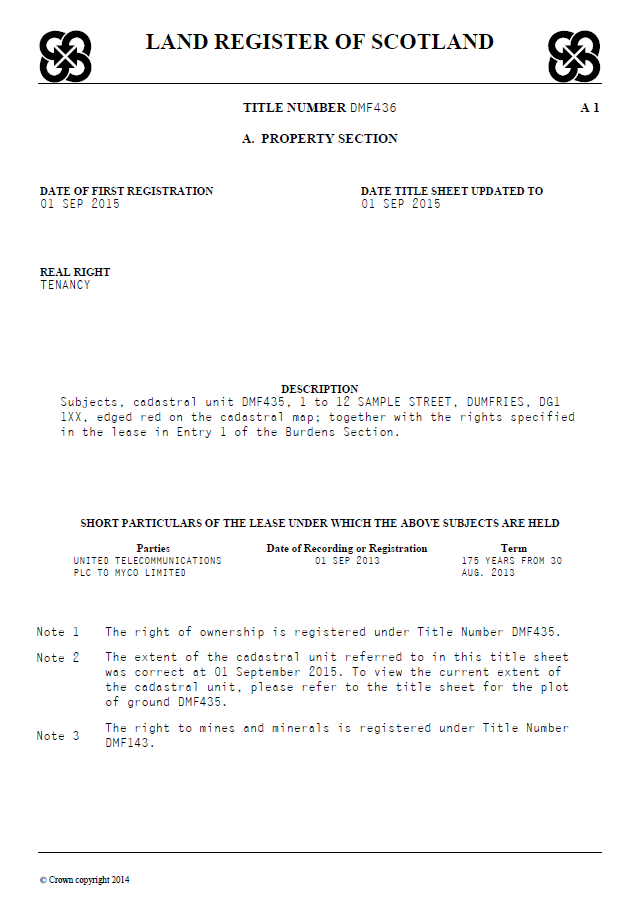
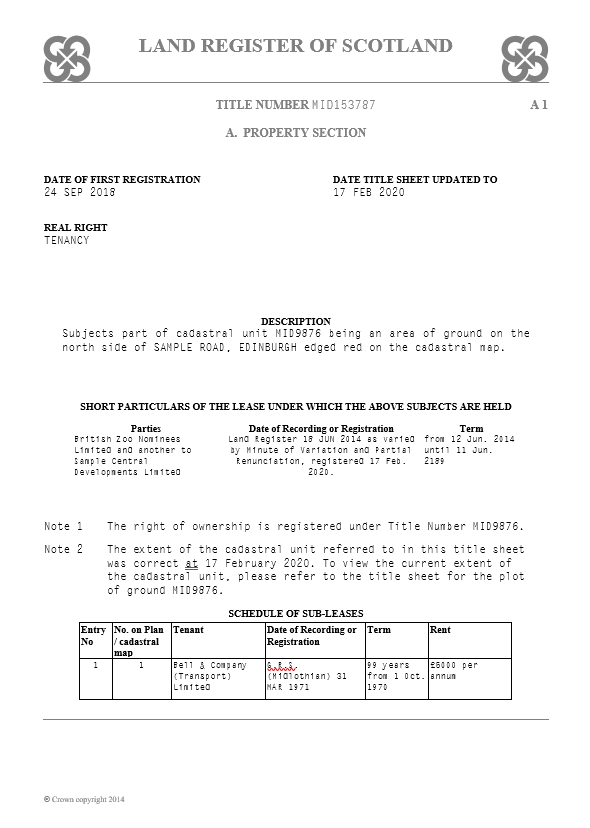
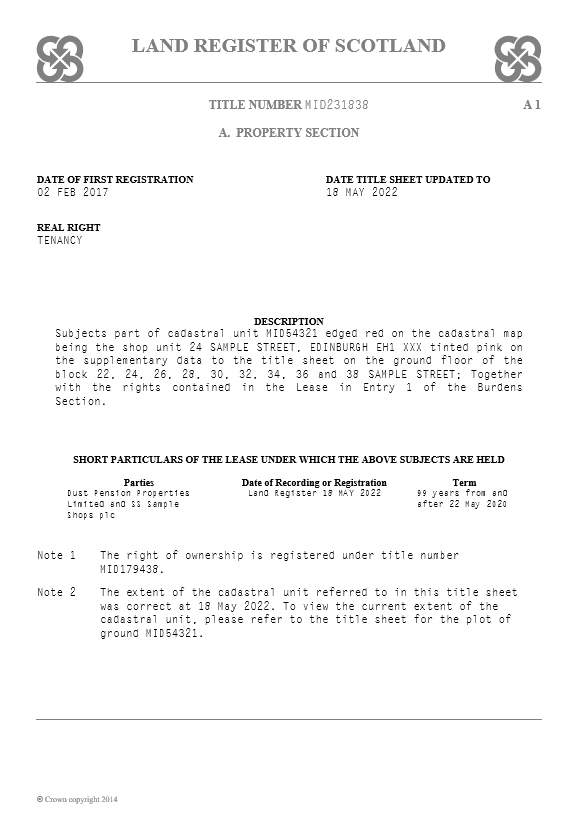
The lease title sheet will comprise the property, proprietorship, securities and burdens sections. The most significant difference to a plot of land title sheet is that the property section will include details of the leasehold interest to which the title sheet relates. A lease title sheet does not have its own cadastral unit. Instead, it is a subordinate title sheet which relates to the title sheet for the plot of land, therefore, the property section of a lease title sheet will contain a reference to the cadastral unit number and the title number for the relative plot of land. The title sheet for the cadastral unit will contain information on the lease in a schedule of leases in the property section and a note regarding the rights of the tenant in the burdens section - see examples of schedules at Property Subject to a Lease within Property Section Information and tenant's rights notes below at Landlord's Tite Sheet - Burdens Section.
A lease title sheet should not be created if the lease no longer subsists, e.g. the term has expired or the lease provided for termination in the event of the insolvency of the tenant. Any such instance should be referred to a senior caseworker.
Property Section
The property section for a lease title sheet differs from that for the plot of land in the following ways:
- the REAL RIGHT will be Tenancy;
- short particulars of the lease will be narrated;
- no mineral reservation note will be added (although if registered as a separate tenement details of that fact will be disclosed);
- a note regarding the ownership of the plot of land will be added (see Additional notes below);
- a note regarding the currency of the cadastral unit will be added (see Additional notes below).
Where the property has itself been sub-leased then the property section will include both the short particulars of the lease pertaining to the title and also a schedule providing details of the sub-lease.
Rights
When examining the rights and conditions in a lease, care should be taken not to inadvertently create a right of property when only a condition or right of use is created in the lease. In particular, a tenant cannot enter into a servitude, nor can a servitude right be created in an assignation or sub-lease.
It is acceptable to create rights of use that are similar to servitudes, e.g. right to use services within a whole building that is held under a leasehold title.
As all commercial leases will be incorporated into the title sheet by reference to the archive record, a cross reference for rights should be added to the property section, as shown in the examples above.
Additional notes
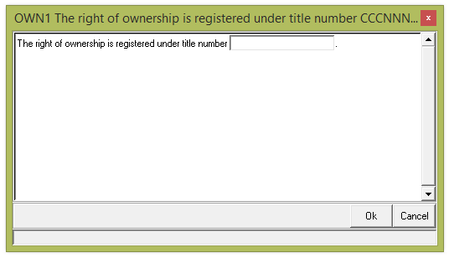
On those lease title sheets that follow the 2012 Act style of referring to the cadastral unit number of the plot of land (ownership title), additional notes are required in the property section. These notes can be found in the LRS picklist:
1. Details of the ownership of the plot of land.
This note can only be added if the plot of land (ownership title) is already registered, or is being registered at the same time as the lease (for example, an APR application), as the cadastral unit number for the plot of land must be entered in the note.
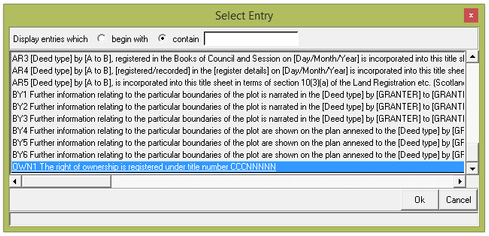
2. The currency of the cadastral unit.
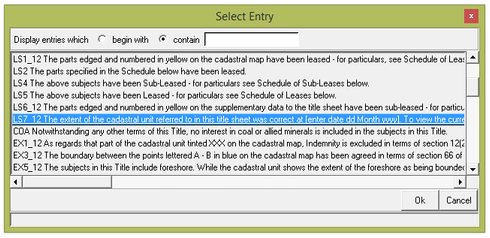
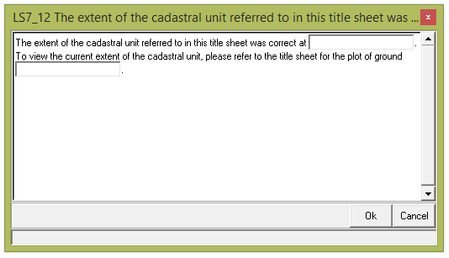
This note can only be added if the plot of land (ownership title) is already registered, or is being registered at the same time as the lease (for example, an APR application), as the cadastral unit number for the plot of land must be entered in the note.
This note is required to capture the extent of the cadastral unit referred to in the lease title sheet on the date that the lease is registered. Therefore, if a lease refers to ancillary rights over the cadastral unit rather than over a specific area shown on the lease deed plan, there is no need to update the lease title sheet or provide additional plans references should the extent of the cadastral unit change in the future.
For example, the lease is for a sub-station site within the first phase of a large housing development and verbally refers to ancillary rights within the cadastral unit. The developer subsequently acquires additional ground and registers it as an Add To to the original cadastral unit or starts selling off units from the development. Without this note Plans consideration would be needed every time an update was made to the registered cadastral unit extent.
3. Previous removals from the cadastral unit
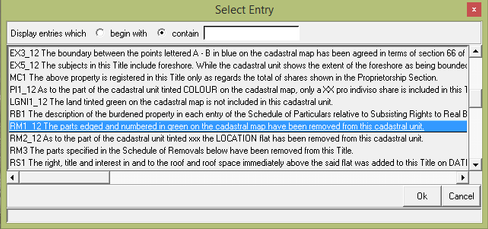
If the plans settler has brought forward green edges and numbers to show previous removals from the landlord's cadastral unit, the general removals note must be added to the lease title sheet. The plans settler should have included an LRS title note requesting the addition of this property section note.
4. Previous feus from the cadastral unit
If the plans settler has brought forwards blue edges and numbers to show previous feus from the landlord's cadastral unit, a note regarding these feus must be added to the lease title sheet. The plans settler should have included an LRS title note requesting the addition of this property section note.
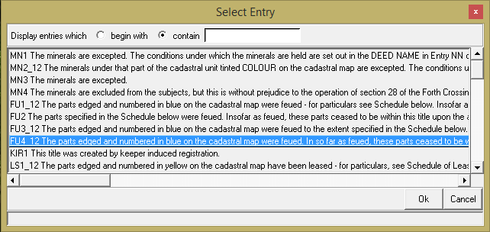
Proprietorship Section
In general terms, the particulars entered in the proprietorship section of a title sheet for the tenant's interest in a lease are identical to those entered in that section for an ownership title to the property. However there will be cases where the particulars entered will differ and examples of these are provided below.
| Useful links |
|---|
| Proprietorship Section Entries |
Consideration
Where the deed giving title to the registered proprietor is the lease itself, the rental (qualified as appropriate), in the absence of any other consideration, should be entered in the ‘Consideration’ column e.g.:
Consideration:
Rent £25,000 per annum
(Subject to review)
In situations where the clause setting out the rental provisions is complex this should be reflected by reference to the entry in the burdens section for the lease itself, which will include the full details, e.g.:
Rent as specified in the Lease in Entry 1 of the Burdens Section
Destination
Most modern commercial leases contain a provision that the consent of the landlord must be obtained for any assignation or sub-lease thereof, or state that the lease is granted in favour of the tenant "(but excluding sub-tenants or assignees without the prior written consent of the landlord, which consent will not be unreasonably withheld)”. This provision may appear in either the destination or the burdens clauses of the lease. If it is contained in the burdens clauses, it should be included in the burdens entry. If it is contained in the destination, it should be reflected in full in both the proprietorship section and the burdens section of the title sheet. In the proprietorship section it should be included as part of the destination. The incorporation of the lease by reference into the title sheet ensures that it is included in the burdens section, however it is not for the Keeper to seek evidence of compliance on subsequent transactions.
Inhibitions
As with an ownership title it is for the applicant to consider the potential effect of an inhibition against the tenant when answering the ROI question on the application form. The following is guidance to assist registration officers considering an inhibition recorded between the date of certification of the information given in the form and the application for registration.
The question of whether or not a lease is affected by an inhibition against the tenant hinges on whether or not the lease is adjudgeable, which in turn is determined by whether or not the lease is freely assignable without the consent of the landlord. If the lease contains a stipulation that it cannot be assigned without the consent of the landlord, then that lease is not freely assignable and cannot be adjudged. The general principle is that it will not therefore be struck at by an inhibition against the tenant. Conversely, a lease which can be freely assigned without any requirement for the landlord’s consent is adjudgeable and will be struck at by any future inhibition against the tenant.
The position as regards sub-leases is somewhat unclear, but it is generally thought that inhibitions will strike at sub-leases where there is unfettered power to sub-let. If that view is correct, it would presumably follow that, where the power to sub-let is conditional on the landlord’s consent, the reverse holds good.
It should be borne in mind, however, that this is a particularly complex area of law. For instance, it may be that a lease would be deemed to be freely assignable (and therefore struck at by an inhibition) notwithstanding a stipulation requiring the landlord’s consent, if the stipulation is qualified by such words as: ‘which consent shall not be unreasonably withheld’. Any case in which a tenant becomes inhibited and the registration officer considers that the inhibition may not strike at the interest should, therefore, be referred to a senior caseworker.
Sequestration
Any case where the landlord or tenant is sequestrated should be referred to a senior caseworker.
Securities Section
The particulars entered in the securities section of a title sheet for a heritable security affecting the tenant's interest in a lease are identical to those entered in that section for a heritable security affecting the plot of land. Section 8(1) of the 2012 Act provides that the Keeper must enter in the securities section of the title sheet "particulars of any heritable security over the right in land to which the title sheet relates". The phrase in italics makes it clear that it is not appropriate for a heritable security affecting the right of the owner of the plot, or the right of a head-tenant (where the lease title sheet relates to a sub-lease), to be entered in the securities section of a lease title sheet.
| Useful links |
|---|
| Securities Section Information |
Consent of creditor to grant of lease
Where a heritable proprietor has granted a standard security over his property and then leases the plot of land affected in whole or in part, no evidence of consent of the creditor to the lease requires to be examined by the registration officer. Unless standard condition 6 in Schedule 3 to the Conveyancing and Feudal Reform (Scotland) Act 1970 has been varied or disapplied then such consent may be necessary, but this is not a matter for the Keeper; it is for the parties to decide whether consent is necessary. The registration officer will rely upon the certification given in the application for registration of the lease.
As lack of consent, where consent is necessary, would merely render the lease voidable at the instance of the creditor, it is not necessary to exclude or limit warranty in the unlikely event that the parties to a transaction indicate concern. This is because the right of the tenant is valid at the time of registration but may later be rendered invalid if a decree of reduction is obtained by the heritable creditor. The default warranty given by the Keeper at the time of registration of the lease is limited to the date of registration and is not a continuing warranty.
Security affects only part of a lease title sheet
If a security affects only part of the subjects leased, this will have to be reflected in the securities section of the title sheet.
Where this is done by way of an appropriate written description of the secured subjects (e.g. reference to one unit in a block including floor level and location), this can be reflected in the entry, e.g.:
Standard security by debtor to creditor (designed) over shop premises 3/2 The Mall on 3rd floor ...
Where the secured subjects are identified by way of a plan to the security, no reference should be added to the cadastral map; this is because the cadastral map reflects information relating to the ownership interest of the plot of land. Instead, the entry in the securities section should refer to the plan annexed to the deed in the archive record, e.g.:
Standard security by debtor to creditor (designed) over that part of the subjects in this title [edged/tinted xxx] on annexed plan ...
Note: A copy of the plan annexed to said standard security is incorporated as supplementary data in terms of section 10(3)(a) and 11(1)(a) and (8) of the Land Registration etc. (Scotland) Act 2012.
Title sheet for leasehold interest created in terms of 1979 Act
If, in the foregoing circumstance, the title sheet includes a standard security over the landlord's title (because no evidence of consent of the creditor was submitted with original application), the security can be removed from the title sheet when updating it to comply with the 2012 Act requirements.
No limitation of warranty is required.
Burdens Section
Section 9 of the 2012 Act determines the conditions which require to be entered in the burdens section of a title sheet.
The key points to note are that, in a lease title sheet, the burdens section will:
- disclose only the lease conditions, and will not disclose any real burdens, servitudes or other registrable encumbrances affecting the plot of land (section 9(1)(a));
- where the lease title sheet relates to a sub-tenancy, it will only contain the conditions of the particular sub-lease (and not the head lease).
| Useful links |
|---|
| Styles of preambles for entries |
Section 9(1)(a) requires that where the right in land to which the title sheet relates is encumbered with a title condition that the terms of the title condition are entered in the burdens section of the title sheet. It is important to note that the right in land to which the title sheet relates must itself be encumbered by the title condition. For a lease title sheet that means it is the leasehold conditions that directly affect the interest being registered that are disclosed, including those in a partial assignation, deed of conditions affecting the lease or variation of lease, but not real burdens and encumbrances that affect the plot of land. Such a title condition or real burden affecting the land must be entered in the title sheet for the plot of land, but does not require to be disclosed in a lease title sheet. This does not mean that the real burden or title condition affecting the land could not be enforced against the tenant; whether a particular real burden or condition can be enforced against a tenant is determined by section 9 of the Title Conditions (Scotland) Act 2003.
The other requirement is to disclose the existence of any sub-lease; this is achieved by entering a schedule of sub-leases in the property section and adding the following note to the burdens section of the title sheet.
"Note: the rights of the tenants under the Sub-Leases specified in the Schedule of Sub-Leases in the Property Section are burdens on the subjects in this title."
Summary
It is the conditions encumbering the right of the tenant (i.e. the right to which the title sheet relates) that must be entered in the burdens section of the lease title sheet - NOT the real burdens and conditions which encumber the plot of land to which the lease relates.
A lease title sheet should not be created if it appears the lease may have terminated due to breach of a condition (e.g. automatic termination in the event of sequestration of the tenant); any such instance should be referred to a senior caseworker.
Incorporating Commercial Lease by Reference to the Archive Record
Most commercial leases are complex documents that impose separate obligations on both landlord and tenant. These obligations are often inter-dependant and such documents are often drafted in separate clauses with headings and side notes for ease of identification and cross reference. Typically, the document must be viewed as a whole and read as a whole, therefore, attempting to create a burdens entry in the normal way can make the interpretation of an already complex deed infinitely more difficult.
To avoid these difficulties all leases should be incorporated in the title sheet by reference to the archive record.
Assignations and Variations
For the avoidance of doubt, in situations where Assignations and/or Deeds of Variation contain further leasehold conditions, they should also be incorporated in the title sheet by reference to the archive record.
Land Tenure Reform (Scotland) Act 1974
In terms of section 8 of the Land Tenure Reform (Scotland) Act 1974, every lease granted after 1 September 1974 has an implied condition that no part of the subjects let shall be used as, or as part of, a private house. Breach of this condition makes the lease voidable at the instance of the landlord. A footnote is added to the entry for the Lease.
"Note: the foregoing lease was executed after 1 September 1974 and is subject to the provisions of Part II of the Land Tenure Reform (Scotland) Act 1974."
Leases - Irritancy, Casualty and Other Conditions
Irritancy Clause
Any irritancy clause in a lease should normally be included in full in the relevant entry in the burdens section.
Exception
The only exception is where the irritancy clause is rendered unenforceable by virtue of section 5 of the Leasehold Casualties (Scotland) Act 2001 (hereafter ‘the 2001 Act’), which places a further restriction on the ability of landlords to irritate certain types of lease. In any lease granted:
- before 10 August 1914 and
- for a period of not less than 175 years (as provided for by S1(1) of said Act) and
- for a rent or tack duty which does not exceed £150 per annum [N.B. this relates to the original rent payable],
the irritancy clause is rendered void from 10 May 2000. In any case where the current tenant has taken entry on or after 10 May 2000 and the lease falls within the above criteria, any irritancy clause contained in the lease should be omitted from the burdens section of the title sheet. In that exceptional case, the irritancy clause will be handled as follows:
It is stressed that the omission or removal of irritancy provisions is appropriate only where the lease fulfils the three requirements in section 5 of the 2001 Act.
Leasehold Casualties
A leasehold casualty is a provision in a lease which imposes a requirement for payment of a lump sum additional to the rent to the landlord, on the occurrence of specified events or at specified times. Unfortunately, the lease itself rarely, if ever, uses the specific word ‘casualty’, so, for the avoidance of doubt, a leasehold casualty can be simply described as any obligation in a lease to pay money to the landlord on the happening of any specific event. For the avoidance of doubt, a penalty is not a casualty.
Registration officers must take great care when they encounter leasehold casualties. First and foremost, they have to remember that it is not the case that all leasehold casualties are extinct. Several times in the past, registration officers wrongly edited out leasehold casualties that were still subsisting, which left the Keeper exposed to very large indemnity claims.
Section 16 of the Land Tenure Reform (Scotland) Act 1974 rendered casualty provisions in leases executed on or after 1 September 1974 unlawful, but landlords remained entitled to enforce casualties in leases executed before that date. The 2001 Act provides for extinction of many, but not all, casualties which survived the 1974 reform.
Which casualties are rendered extinct?
The 2001 Act declares that any casualty provision in a ‘relevant lease’ is void. A ‘relevant lease’ is defined as a lease granted before 1 September 1974 and for a period of not less than one hundred and seventy five years. Where a lease contains a provision requiring the landlord to renew, the renewed period is to be added to the original duration when determining whether or not the lease period exceeds one hundred and seventy five years.
Which casualties remain subsisting and enforceable?
Casualties in leases having durations of less than one hundred and seventy five years which were executed prior to 1 September 1974 remain subsisting and enforceable and must, on registration of the tenant’s interest, be entered in the burdens section of the title sheet.
Date of extinction
The date of extinction of those casualties rendered void by the 2001 Act is 10 May 2000.
Registration Implications
Conditions of let
Conditions may be discharged, modified, etc. by minutes of agreement, deeds of variation, waiver etc. and also (under certain exceptions) by an order of the Lands Tribunal (see Part I of the Conveyancing and Feudal Reform (Scotland) Act 1970 (now repealed) and Part 9 of the Title Conditions (Scotland) Act 2003).
Variation of Lease
General
Section 52(2) of the 2012 Act amends the Registration of Leases (Scotland) Act 1857 to permit the registration of certain events that affect a registered lease, including deeds that vary the terms of a lease.
Under the 2012 Act, the Keeper no longer registers interests in land. Instead, the Land Register becomes a register of rights in land, and the plot of land becomes the unit of registration. Once the plot of land is registered all rights in land, including subordinate real rights such as leases, stem from that registration and effectively become part of the Land Register. Consequently, where the plot is registered but there is no lease title sheet, the deed of variation must be registered against the plot title sheet (and must narrate the plot title number within the deed); the deed should not also be recorded in the Sasine Register.
If there is an existing lease title sheet, the Keeper will accept the application to register the deed of variation if submitted against only that title (provided it is not extending the extent of the subjects let, which is effectively a grant of a new lease and should describe the subjects appropriately). Details of the variation will only be noted on the landlord's title sheet if an application is made against that title (e.g. a TP from that title when adding additional subjects).
For details on how to reflect a variation of lease in a lease title sheet, please see the section Entry in Title Sheets below.
Extension/Reduction of leased subjects
Addition of subjects into a lease
Section 52(2) of the 2012 Act applies to deeds that vary registered leases to include additional areas of land. The deed is treated as a new grant of lease over the additional subjects and is acceptable for registration provided:
- the essentials of a valid lease are complied with (parties, rent, duration, property),
- the deed is valid, and
- the deed is registrable, i.e. the deed is self-proving, and the remaining duration of the original lease is in excess of 20 years.
As a grant of a new lease of the additional subjects, such variations of lease will trigger Automatic Plot Registration (APR) in terms of section 24(2), where the plot of land is unregistered.
The plot to be registered when APR is triggered in these circumstances will comprise the original leased subjects plus the additional subjects, since this combined geographical area is now the “subjects of the lease” in terms of section 25(5)(a).
See APR - Variation and/or extension of Lease scenarios and outcomes below for the outcomes for a variation of a lease that extends the extent. The addition of property into an existing lease title sheet will require that it be updated to comply with the terms of the 2012 Act.
Reduction of subjects leased
A variation of lease may reduce the subjects leased by incorporating a partial renunciation of lease. Guidance in respect of partial renunciations of leases is available at Termination of Lease below and Termination/Renunciation of Lease Processes and How to Map a Renunciation or Partial Renunciation of a Lease
Variation extending term of lease
Where the plot is unregistered but a lease title sheet exists, the deed should be registered against the lease title sheet.
Where neither the plot nor the lease has been registered, the deed of variation should be recorded in the Sasine Register - unless it also incorporates additional subjects into the lease, or where the variation extends the term of a short lease to exceed 20 years.
- Where it also incorporates additional subjects into the lease, it will trigger APR - see APR - Variation and/or extension of Lease scenarios and outcomes above.
- Where the term of a lease that was previously for less than 20 years is varied with effect that the term exceeds 20 years, this would require registration of the lease to make the tenant's right real. Consequently, if the plot of land affected by the lease is not already registered then the variation would trigger APR - see APR - Variation and/or extension of Lease scenarios and outcomes above.
Where the plot is registered and a lease title sheet exists, the deed should be registered against the lease title sheet. There is no requirement to register the deed against the plot title sheet. However, if the deed is presented for registration against the plot title sheet, the Keeper will update the title to reflect the deed.
Where the plot is registered but there is no lease title sheet, the deed must narrate the title number of the plot title sheet and be registered against the plot title sheet. This would trigger a transfer of part application from the plot title sheet.
Variations that incorporate additional subjects, where the remaining duration is less than 20 years
It should be noted that where a variation of lease which purports to incorporate additional subjects and vary other aspects of the original lease (such as altering the terms) is submitted for registration, but where the remaining duration of the lease is less than 20 years, the Keeper will accept the deed for registration but will only give effect to it in so far as it comprises a deed capable of registration (i.e. the deed will be registered to reflect those parts which affect the subjects already registered under the original lease, but the additional subjects will not be incorporated into the lease title sheet and APR will not take place).
In these circumstances, where we are giving effect to only the part of the deed that is registrable, it may be difficult to edit the deed to show only those parts. For the avoidance of doubt, the legal settler should incorporate the Variation by reference to the archive record and the following note should be added to the entry in the burdens section:
Note: The foregoing Variation of Lease has been registered only in respect of that part of the variation which is registrable, being that it alters the terms or conditions as therein described relating only to the existing registered extent of the tenant’s interest as at the date of registration of this deed.
Entry in title sheet(s)
The variation should be reflected in both the burdens section and the property section of the lease title sheet. In the burdens section, the deed should be incorporated by reference to the archive record. There is no requirement to add a note at the end of the burdens section entry for the lease to indicate that the lease has been varied. In the property section, if the term of the lease is being extended, then the existing end date in the schedule of short particulars should be replaced with the new one. If the variation amends the lease in any other way, then the Keeper will retain the existing schedule details, but will add that the lease has been varied, e.g.:
| Parties | Date of recording/registration | Term |
|---|---|---|
| Primo Limited to Secundo PLC | Land Register 1 Feb. 2020 as amended by deed of variation registered 3 Apr. 2024 | 30 years from 10/01/2020 |
Details of the variation will only be noted on the landlord's title sheet if an application is made against that title. The full terms of the variation do not require to be shown in the title sheet of the landlord's interest; if an application is made to register the deed against the landlord's title, the variation should only be reflected in the schedule of leases in the property section.
Where the landlord's title is being updated to reflect a variation, the method of updating depends on the matter being varied. If it is information disclosed in the schedule (i.e. term or rent), then this should be updated and text added to reflect that the lease has been varied, as set out below. If the matter varied is not detailed in the existing schedule, the Keeper will only add information to the effect that the lease has been varied: the original details of the lease as set out in the schedule should remain unchanged, e.g.:
Entry | No on Plan | Tenant | Date of recording/registration | Term | Rent |
1 | 1 | Solar Scotland Renewables Ltd | Land Register 16 Mar. 2014 under lease title sheet STHxxxx as amended by deeds of variation registered 16 Mar. 2014 and 8 Jan. 2016 | From Martinmas 2004 until 31 December 2075 | £10,000 |
When processing an APR application, the schedule of leases should reflect the details of the lease (rent and/or term) as amended by the variation being registered reflecting the up to date position as regards the lease.
Partial Assignation of Registered Lease
An assignation of lease is a registrable deed that transfers the right of the existing tenant to a new tenant. No new level of leasehold interest is created (to create a new level of leasehold interest a Sub-Lease would be required). When the assignation is a full assignation of a lease, the whole of the existing tenant's rights transfer to the new tenant. When the assignation is a partial assignation of a lease, the existing tenant's interest is divided into two (or more) lease titles - the existing tenant retains their rights in part of the leased subjects, whilst the new tenant is granted (or assigned) the rights in a further part of the leased subjects.
- If the underlying plot of land (the ownership title) is unregistered, the registration of a full or partial assignation of a registered lease does not trigger APR.
- If the lease is a registered lease, an application to register a full assignation will be processed as a DW application.
- If the lease is a registered lease, an application to register a partial assignation will be processed as a TP application from the existing lease title sheet, and an application will also be required over the title sheet for the plot of land (if registered) to update the schedule of leases. In the absence of any live DW applications, a TU should be created to facilitate the update.
- If the lease is a recorded lease (i.e. still in the Sasine Register), consideration should be given to whether the application triggers APR.
Key points for settlers
There are 4 main scenarios that each require a different method for settling the application to register the partial assignation:
Existing lease title sheet | Plot of land under the original leased area | Follow guidance in ... |
|---|---|---|
| 2012 Act style | Registered in the 2012 Act style | Scenario 1 |
| 1979 Act style | Unregistered | Scenario 2 |
| 1979 Act style | Registered in the 2012 Act style | Scenario 3 |
| 1979 Act style | Registered in the 1979 Act style | Scenario 4 |
See Plans guidance on How to Map a Partial Assignation of a Registered Lease for further information.
Scenario 1
Scenario 2
Scenario 4
Introduction
A standard security may be granted over a plot of land, or it may be granted over an existing subordinate real right, e.g. the tenant's right in a lease or sublease, or the creditor's right in an existing standard security. The Register of Sasines is now closed to all standard securities, and since the recording of a standard security no longer has any effect, all standard securities must be registered in the Land Register, including those over unregistered subordinate real rights.
The registration requirements for such deeds will depend on a number of factors, and different considerations apply to standard securities over leases or subleases as apply to standard securities over standard securities. Guidance on applications to register standard securities over the tenant's right in a lease or sublease is provided below. The page Securities Section Information contains some further information on standard securities over standard securities.
Standard security over lease or sublease
Where an application is received to register a standard security over a lease or sublease, the following points should be considered:
- Is the lease a registered lease, for which a lease title sheet exists?
- Is the lease a recorded lease (i.e. still in the Sasine Register)?
- Is the underlying plot of land (the ownership or landlord's title) registered?
- Is the lease a "deemed registered" lease? (If the plot of land is registered, all subordinate real rights that were previously recorded in Sasines become 'deemed registered').
Where the plot of land to which the lease or sublease relates is registered, APR need not be considered. However, in these circumstances consideration must be given to whether the lease or sublease is registered or "deemed registered". A consequence of the plot of land being registered is that all subordinate real rights that were previously recorded in Sasines become deemed registered, i.e. such rights are considered part of the Land Register, and effectively stem from the registered plot.
Registered: Where the standard security relates to a lease or sublease for which a lease title sheet exists, the application can be processed as a DW over the lease title sheet.
Deemed registered: Where the standard security relates to a "deemed registered" lease or sublease, the application must be submitted against the plot title sheet, and the deed must narrate the plot title number. A new lease title sheet will be created for the lease or sublease, on which the standard security can be entered. In cases where the standard security is granted over a deemed registered sublease, and a title sheet exists for the head lease, the process is the same, i.e. the standard security application must still be submitted against the plot title sheet, and the deed must narrate the plot title number.
Where the plot of land to which the lease or sublease relates is unregistered, consideration must be given to whether or not APR is triggered by the standard security application.
- Where the lease or sublease to which the standard security relates is registered, and a lease title sheet exists, APR is not triggered. Examples of transactions affecting registered leases where the registrable deed does not induce APR can be found under Automatic Plot Registration above.
- Where both the plot of land and the lease or sublease are unregistered, APR will be triggered. Two new title sheets will be created, one for the plot of land and one for the lease or sublease.
Scenarios and outcomes
Various registration outcomes where a standard security over a lease or sublease is submitted are set out below.
Sub-Leases
Applications to Register a Sub-Lease
A sub-lease creates a new level of leasehold interest, being that of the sub-tenant. A lease title sheet relating to a sub-tenancy will only contain the conditions of the particular sub-lease registered, and not those of the head lease. For further information, see Lease title sheet above.
When considering any application to register a sub-lease, registration officers should ensure that it meets the requirements of registration.
The provisions of Automatic Plot Registration detailed above apply to sub-leases. In all applications to register a sub-lease, the registration officer should identify if the plot of land (the owner's title) is registered.
| Useful links |
|---|
| How to map a Sub-Lease |
Ultra long leases
The Long Leases (Scotland) Act 2012 came into effect on 28 November 2015 and, as a result, certain ultra long leases are converted into ownership. It may appear from the deeds submitted that an applicant holds rights as tenant in a long lease, but consideration must be given to whether their apparent right has converted into ownership. Please see the Conversion of Long Leases for further information.
Validity of sub-leases
In a situation where a head lease is not recorded, or has been recorded but the recording is invalid, a sub-lease out of it may still be registrable, provided the head lease meets the criteria for validity for an unrecorded lease and the sub-lease meets the requirements for a registrable lease. It is not competent for the tenants in a lease to grant a sub-lease for a period exceeding the term of their own lease.
For the avoidance of doubt, the principle of tacit relocation cannot be used when calculating the term of the sub-lease. Tacit relocation applies to all leases whereby neither the landlord or tenant gives notice to quit at the end of the lease term; it is never included within the lease itself and would not satisfy the definition of a long lease, as set out in section 17 of the Registration of Leases (Scotland) Act 1857, as amended by the Land Tenure Reform (Scotland) Act 1974. Indeed, to include tacit relocation in the calculation of the term of a lease (or sub-lease) would allow every lease to be registrable.
Where a registration officer encounters a scenario whereby the sub-lease appears to have been granted for a longer period than the head lease, the application should be referred to a senior caseworker to examine and, if appropriate, authorise rejection.
Termination of head lease
The impact on a sub-lease where there is an attempt to terminate the head lease is discussed in Termination of Lease below.
Sub-leases incorporating variation of the head-lease
Registration officers may encounter instances where the landlords vary the terms of the head lease within the sub-lease. The sub-lease should be processed as either a Transfer of Part or a First Registration following the guidance above. In situations where the plot is registered (whether prior to the sub-lease being submitted or as a result of APR) and the head lease is unregistered, no separate application will be required in respect of the variation. As a result of the plot being registered all rights in land, including subordinate real rights such as leases, stem from that registration and effectively become part of the Land Register at that time.
Where the head lease is registered, the deed should also be presented for registration against the head lease as a Dealing of Whole. The Keeper's policy is to incorporate all leases by reference to the archive record. The reason for this is because commercial leases are complex documents that impose separate obligations on both the landlord and tenant. Any attempt to edit the deed to show only what are perceived to be the burdens affecting the tenant’s interest can destroy the coherence of the deed and raises the very real danger that certain obligations will become unenforceable from lack of specification. An entry should be made in burdens section of the head lease title sheet;
"Sub-Lease and Variation of Lease in Entry X among A, B and C, registered XXX is incorporated into this title sheet in terms of section 10(3)(a) of the Land Registration etc. (Scotland) Act 2012:"
For the avoidance of doubt, where a sub-lease and variation creates additional rights in favour of the tenant in the head lease, a cross reference should be added to the property section;
"Together with (One) the rights specified in the Lease in Entry X of the Burdens Section; and (Two) the rights specified in the Sub-Lease and Variation in Entry X of the Burdens Section."
Interposed Leases
Section 17 of the Land Tenure (Scotland) Act 1974 permits the creation of interposed leases. These allow a landlord to grant a lease of land already leased for a longer or shorter period than, or of the same duration as, the existing lease, but subject to the existing lease. This is presumably equivalent to a sale or lease of the right to collect the rent and enforce the conditions in the existing lease for a specified term. The new interest is referred to as an interposed lease.
An example of this would be where a development company has completed a project and, having leased out the individual units, wants to retain the development as an investment without having to deal with its day to day management. They can achieve this by interposing a lease to a management company between them (the development company) and the tenants of the individual units. The tenants of the individual units are now sub-tenants and responsible to the management company who is their new landlord.
When considering any application to register an interposed lease, registration officers should ensure that it meets the requirements of registration as detailed under Examination of Applications Relating to a Lease above.
The provisions of Automatic Plot Registration detailed above will also apply. Where the plot of land (the owner's title) is not registered the grant of an interposed lease will trigger APR.
From a practical point of view the result will be that:
- the schedule of leases in the property section of the ownership title sheet should disclose details of the interposed lease (details of the original lease(s) need only be shown if its term will continue beyond the termination date of the interposed lease).
- the property section of the title sheet for the interposed lease will disclose the short particulars of the interposed lease (see Property Section Information for style) and will also contain a schedule of leases giving details of the original lease(s). The interposed lease will be incorporated by reference into the title sheet from the archive record in the burdens section and a tenants rights note added.
- Where the original tenant's interest is registered, on the grant of an interposed lease it will be necessary to consider what terms of the interposed lease require to be included in the burdens section of the title sheet.
Because of the inherent complexity of such transactions, all instances of interposed leases should be referred to a senior caseworker.
| Useful links |
|---|
| Mapping Leases |
Termination of Lease
General
Section 52 of the 2012 Act makes certain amendments to the Registration of Leases (Scotland) Act 1857, and provides that any registrable deed terminating a registered lease is registrable in the Land Register. Section 48(1)(d) of the 2012 Act also provides that the recording in the Register of Sasines of any deed relating to a registered lease has no effect.
Where an application for the termination of a registered lease is submitted for registration, separate application forms against both the landlord's and tenant's titles are not required.
An application to register a deed that terminates a registered lease, where the underlying plot of land is unregistered, is not currently a trigger for automatic plot registration.
For termination of leases, both a renunciation and a decree of irritancy are registrable deeds - see guidance below.
If, as part of an application, it is highlighted that a result of the registration will be to extinguish an interest by the operation of confusio, then the absorption should be given effect to as part of the registration process - see further guidance at Confusio below.
It is also possible to clear the register of a lease terminated by other means - see guidance below. If the title is being rectified, the rectification officer must examine the evidence submitted in support of the application to ensure that it is sufficient to terminate the lease.
Renunciation/Partial Renunciation
Tenant's Interest in Land Register
Where a lease title sheet exists, a renunciation will be given effect to by way of registering the deed against the lease title sheet, regardless of whether the landlord's title is registered or not. The renunciation need only narrate the lease title number.
Given the terms of section 48(1)(d) of the 2012 Act, where the landlord's title is in the Sasine Register, but a lease title sheet exists, the renunciation need only be registered against the lease title sheet. Joint recording of the deed in the Register of Sasines is not required.
Where there is a lease title sheet but the landlord's interest remains in the Sasine Register, and the deed submitted is a full renunciation, then the lease title sheet should be closed. An appropriate note should be added to the search sheet for the landlord's title, e.g.
Lease by AB to CD recorded/registered dd mmm yyyy has been renounced in terms of Renunciation registered dd mmm yyyy. [title no. for lease] closed and absorbed into this title.
Where there is a lease title sheet but the landlord's interest remains in the Sasine Register, and the deed submitted is a partial renunciation, then the lease title sheet should be amended as appropriate. An appropriate note should be added to the search sheet for the landlord's title, e.g.
Lease by AB to CD recorded/registered dd mmm yyyy has been partially renounced in terms of Renunciation registered dd mmm yyyy. Extent of renounced subjects removed from [title no. of lease] and absorbed into this title.
Where both landlord's and lease title sheets exist, the deed is given effect to by registering the renunciation against the lease title sheet, and closing the lease title sheet. An internal application should be created (following guidance at Termination/Renunciation of Lease - Intake) to remove reference to the lease from the landlord's title sheet. Where a partial renunciation is submitted the lease title sheet should be amended as appropriate, and the landlord's title sheet updated accordingly.
Tenant's Interest in sasines
Where the tenant's interest in a lease is in sasines, but the plot to which it relates is registered, a renunciation of that lease must be given effect to in the Land Register. Under the 2012 Act, as a consequence of the plot of land being registered, any subsidiary real rights affecting the plot, including long leases, are deemed to also be registered. Therefore, any renunciation of such a lease must be registered against the plot title sheet, and the deed must narrate the plot title number. Recording the deed in the Sasine Register has no effect, however it will be necessary to add an appropriate note to the search sheet to reflect that the tenant's right has been renounced.
Where there is a title sheet for the landlord's title and the previously recorded lease is now deemed registered, on submission of a full renunciation the entry for the lease should be removed from the schedule of leases in the property section; appropriate amendments may also be required to the cadastral map. An appropriate note should be added to the search sheet for the lease e.g.
Lease by AB to CD recorded dd mmm yyyy has been renounced in terms of Renunciation registered dd mmm yyyy - To [title no. for landlord's interest].
Where a partial renunciation is submitted the landlord's title sheet should be amended as appropriate. An appropriate note should be added to the search sheet for the lease e.g.
Lease by AB to CD recorded dd mmm yyyy has been partially renounced in terms of Renunciation registered dd mmm yyyy. Extent of renounced subjects absorbed into [title no. for landlord's interest]'.
For more detailed instructions see Termination/Renunciation of Lease Processes.
For a table of example scenarios, see Termination/Renunciation of Lease - Example Scenarios below.
When registering a renunciation of a sub-lease the application of the above principles must be considered in relation to both the owner's and mid-landlord's titles.
Irritancy
Sections 4 and 5 of the Law Reform (Miscellaneous Provisions) (Scotland) Act 1985 provide forms of protection for tenants against penal enforcement of irritancies in leases. Section 4 makes it mandatory for the landlord to give notice in respect of a termination for non-payment of rent and details the need for the tenant to comply with any notice served in order to obtain protection. Section 5 makes similar provisions in respect of irritancies not relating to monetary breaches. Both sections therefore cover the possibility of termination resulting from all forms of breaches.
With regard to settling procedures it should be noted that irritancies do not become effective without a court decree of extraordinary removing, unless the tenant is willing to remove. Therefore, in the absence of a decree, evidence that the tenant has vacated the premises must be submitted before the tenant's interest is removed from the register. Due consideration must also be given to the position of sub-tenants and heritable creditors when a head lease is irritated; see Termination of lease - effect on subsidiary interests below.
It is not uncommon for tenants to just walk away from premises; in their absence the premises are re-acquired by the landlord and no court action is raised due to the absence of the tenant. In these circumstances, the Keeper will consider lesser evidence than the court decree of the termination of the lease. The required evidence would be in the form of:
- Letter of demand of payment of outstanding rent (reflecting terms of lease and giving a fixed period in which to pay) - the letter may threaten irritancy;
- Notice of Irritancy terminating the lease;
- An affidavit that tenant has vacated the premises;
- If there is an outstanding security, either a statement that no security granted by the tenant affecting the lease had been intimated to the landlord, or evidence that the creditor had been informed of the potential irritancy in terms of the lease (e.g. recorded delivery slip addressed to the creditor, or letter of acknowledgement from the creditor);
- Evidence a condition has been breached - e.g. evidence of the insolvency of the tenant;
- Evidence of a new lease of the premises and occupation by the new tenant.
Confirmation that the submitted evidence is sufficient should be made in consultation with a senior caseworker.
Section 5 of the Leasehold Casualties (Scotland) Act 2001 places a further restriction on the ability of landlords to irritate certain types of lease. In any lease granted:
- before 10 August 1914, and
- for a period of not less than 175 years (as provided for by S1(1) of said Act), and
- for a rent or tackduty which does not exceed £150 per annum [N.B. This relates to the original rent payable],
the irritancy clause is rendered void from 10 May 2000. In any case where the current tenant has taken entry on or after 10 May 2000 and the lease falls within the above criteria, any irritancy clause contained in the lease may therefore be omitted from the burdens section of the title sheet. The procedural implications are discussed in Leases - Irritancy, Casualty and other conditions above.
Confusio
This is a rule of general application to obligations in Scots Law. Where the same person in the same legal capacity becomes both the debtor and the creditor in such an obligation, that obligation is said to be extinguished confusione. In relation to leasehold property, where the same person in the same legal capacity becomes both landlord and tenant in the same lease (e.g. by succession or by disposition or assignation as appropriate), there is now a generally accepted presumption that confusio operates to extinguish the lease, unless the proprietor acts in such a way as to rebut that presumption. It is settled that a lessee who obtains a disposition of his leasehold subjects need only look thereafter to his title as owner for his rights and obligations.
Notwithstanding the foregoing, agents differ in their ways of dealing with property where their client has acquired both leasehold and heritable titles. Many continue to dispone the subjects and assign the lease, while others dispone the subjects omitting the assignation of the lease and not excepting the lease from warrandice.
The intention of the agents will normally be evident from the application for registration (e.g. a statement that the applicant is already proprietor of the other interest), in which case the absorption should be given effect to as part of the registration process - see Absorptions guidance. If there is no indication in the application that an interest has been extinguished by the operation of confusio then the application should be processed as normal; it would then be open to the proprietor to seek rectification of the register if they consider it inaccurate on the basis absorption has operated.
If there is a standard security against the leasehold interest then the title sheet should not be closed unless the security is discharged.
Where it is considered that a lease has been extinguished confusione but that third party rights exist in relation to some of the conditions of let, a burdens entry should be prepared which shows the subsisting conditions.
Expiry of term
The law does not presume that a lease automatically expires at the specified termination date. Instead, the presumption is that it is continued by tacit relocation if neither the landlord nor the tenant has intimated a desire to terminate by sending the other a notice to quit. If such notice is not sent it is assumed that both parties wish the lease to continue, and it is therefore automatically extended (for one year at a time in the case of registrable leases) until formally terminated by either party.
It therefore follows that, in the absence of the appropriate evidence of termination, a title sheet for a registered leasehold interest should not be cancelled, nor should the details of the relevant lease be removed from the landlord's title sheet. Frequently the Keeper will only become aware that a lease has expired when the property (such as a retail unit) is re-let.
A leasehold interest that has time-expired no longer exists and accordingly there is no interest to be absorbed into that of the landlord; the title sheet relating to the tenant's interest just falls to be closed.
If both the landlord's and tenant's interests are registered, the notice to quit should be submitted along with a request to rectify the landlord's title on the basis it is inaccurate in continuing to show the lease. The schedule of leases should be updated to remove the relevant entry relating to the lease (the cadastral map should be updated as necessary); the title sheet for the tenant's interest will be closed as a consequence.
If the landlord's interest remains in the Sasine Register, the request should be made against the tenant's interest and that title sheet should be closed. No entry is required in the Sasine Register; the initial minute on the search sheet should disclose that the term will have expired.
If the landlord's interest is registered but the tenant's interest remains in the Sasine Register the request should be made against the landlord's title; the schedule of leases and cadastral map should be updated as necessary. No entry is required in the Sasine Register; the initial minute on the search sheet should disclose that the term will have expired.
Whenever a title sheet is closed, a plans registration officer should cancel the entry for that interest on the cadastral map.
Notice to quit
Modern leases frequently include review points where it is open to either party to terminate the lease, the exercise of this option will be evidenced by service of a notice to quit on the other party. In practical terms this should be dealt with in the same manner as in Expiry of term above, however, as the notice to quit is neither a recordable or registrable document, and the term has not expired, application should be made to rectify the register, supported by sufficient evidence to support the request.
It will be necessary to add a note to the recorded interest in the Sasine Register to publicise that the lease has been terminated. The note should be worded to clearly identify the lease e.g.
Lease by AB to CD recorded/registered dd mmm yyyy has been terminated in terms of Notice to Quit dated dd mmm yyyy.
Termination of lease – effect on subsidiary interests
When a registration officer is considering whether to give effect to an application to terminate a lease (or another application which presupposes the termination of the lease), the effect of such termination on subsidiary interests must be borne in mind. For example, the tenant may have granted a standard security or a sub-lease. In some cases, there may be a presumption that the subsidiary interest continues (e.g. where a head lease is voluntarily renounced, a sub-tenant may be able to continue to hold his or her sub-lease on the same terms as tenant of the head landlord). In some cases (e.g. where the head lease is irritated), the termination of the lease may have the effect of terminating the subsidiary interest. In other cases (e.g. where the tenant wishes to renounce the lease, but there is an undischarged standard security over it), the existence of the subsidiary interest may restrict the potential for termination of the lease.
In cases where there is an existing standard security against the tenant's title and the lease is being terminated, in most cases you should look for evidence that the creditor has discharged the security or consented to the termination of the lease. This is because the default position of the Keeper is to seek a registration event whenever possible, ahead of rectification. If it is not possible to obtain a discharge from/consent of the creditor, the agent should be asked to submit a Certificate of Consignation.
It is possible that the agent may argue that there is no requirement to submit anything from, or on behalf of the creditor, as he takes the view that the security has ceased to exist on the basis that the lease has fallen, and there is therefore no real right against which the standard security can be registered.
In these circumstances, before a decision can be made to close the tenant's title sheet, the registration officer must be satisfied that the lease has terminated. The evidence of termination may be fairly straightforward, such as confirmation that there has been a natural break in the lease. But another possible scenario which might not be so clear cut is the dissolution of the tenant.
For example, if a request is made to close a tenant's title sheet because they are a company that has been dissolved, the registration officer would require to see objective evidence of the dissolution of the company.
The following list is indicative of the evidence, which taken as a whole, could be regarded as sufficient to close the title:-
- a) Proof from Companies House that the company was dissolved - the date could be important, as it is possible for a company to be restored up to six years after dissolution.
- b) Disclaimer from the KLTR, a copy of which should have been published in the Edinburgh Gazette.
- c) Confirmation that the Tenant is no longer paying rent or in occupation of the subjects and that the lease has not been assigned.
Where a request has been made to close a tenant's title sheet at the breakpoint of the lease, and there is an outstanding security by the tenant, it is reasonable to assume that the creditor had been aware of the breakpoint. In this situation, when the lease has come to an end, the security also comes to an end.
Bear in mind that when a tenant's title is being closed by way of rectification, and there is an outstanding security on that title sheet, the creditor must be notified of the closure.
In all situations where termination of a lease is being considered and there are subsidiary interests extant on the register the case must be referred to a senior caseworker.
Termination/Renunciation of Lease - Example Scenarios
Application to Register a Renunciation or Partial Renunciation of Lease
When considering an application to register a renunciation or partial renunciation of lease, the tables below should be referred to as simple guides.
The guidance below also applies to a renunciation/partial renunciation of a sub-lease. However, consideration must be given to updating the title sheet or search sheet relating to the mid landlord's interest.
| Useful links |
|---|
| Termination/Renunciation of Lease Processes |
Landlord's Title Sheet
General
The title sheet for a plot of land subject to a lease (or multiple leases) only differs from one that is not subject to such leases in the contents of the property and burdens sections.
Where the landlord's title is itself a leasehold title sheet, i.e. in sub-lease scenarios, the following guidance is equally applicable. The guidance below should also be followed when legal settling an APR application.
See Further Guidance section Updating Existing 1979 Act Title Sheets - Instructions for Plans and Legal Settlers for details on updating an existing 1979 Act landlord's title sheet when a new lease or sub-lease affecting that plot of land is being registered.
Property section
The lease should be disclosed in a schedule of leases. In straightforward cases where a simple coloured edge can adequately describe the parts leased, the parts leased will be edged yellow by the plans registration officer. If there is more than one lease, each lease will be given a number which will be reflected in the schedule of leases entered in the property section by the legal registration officer. Where the property leased is on a floor level, then a description of the subjects should be included in the schedule - see examples at Property Subject to a Lease.
If the leasehold interest is registered, the entry in the schedule of leases must include reference to the title number. The title number of the leasehold interest is included in the 'Date of recording or Registration' column by adding "under lease title sheet [title number]" to the "Note" field.
When the subjects (or part) have been sub-leased and the sub-leases are registered, then the title numbers of the sub-lease title sheets must be disclosed in the schedule of sub-leases in the property section of the head lease title sheet (if one exists). No reference to the sub-lease should be disclosed in the ownership title sheet.
Proprietorship section
This should reflect the details of the current owner of the plot of ground let.
Where registration of the plot has been triggered by the effects of sections 24 and 25 of the 2012 Act (APR) then this should be reflected by way of a note added to the proprietorship section, viz.:
Note: The right of the above named proprietor was registered by virtue of section 25 of the Land Registration etc. (Scotland) Act 2012.
- The consideration field should be updated to read Automatic Plot Registration.
- The date of entry should be left blank.
Securities section
This should disclose details of any outstanding security or charge that affects the plot of ground. Where the right of the creditor was created in a deed recorded in the Sasine Register then the entry should include details of the recording and also disclose that the right of the creditor was entered as a consequence of registering the plot in terms of the requirements of sections 24 and 25 of the 2012 Act, e.g.:
Standard Security by said BRITISH COMPANY PLC to BANK OF US PLC, (Number SCO80001) Registered Office 22 Charlotte Road, Edinburgh EH92 4DF, recorded G.R.S. (Fife) 3 Apr 2005, over the subjects in this title and other subjects
Note: The right of the above named creditor was entered on (insert date of registration of APR application) by virtue of section 25 of the Land Registration etc. (Scotland) Act 2012.
Burdens section
Complete the burdens section in the usual way.
Where the subjects are directly affected by a lease held from them (i.e. the head lease on an ownership title or sub-lease from a lease title sheet), a tenants rights note should be added to the burdens section of the landlord's title sheet. The style of note should be as follows:
Landlord's title is to plot of land
The rights of the tenants under the Leases specified in the Schedule of Leases in the Property Section are burdens on the subjects in this title
Landlord's title is as tenant under a lease
The rights of the tenants under the Sub-Leases specified in the Schedule of Sub-Leases in the Property Section are burdens on the subjects in this title
Mixed Ownership/Leasehold Titles
Many titles comprise a mix of property both owned and held under a lease, a situation that arose from a point in time when the grant of a lease was used as a method to work-round a prohibition on sub-feuing property; the consequence being that an area of land bought from neighbouring proprietors could straddle the boundary between the leasehold and ownership interests. A variation on this is where the tenant has also acquired the landlord's interest but the conveyancing has, erroneously, continued to refer to both disponing and assigning the interest. Whatever the cirumstances resulting in a title comprising a mix of ownership and leasehold, it is not a structure of title sheet supported by the 2012 Act.
Long Leases (Scotland) Act 2012
For the reason stated above, about prohibitions on sub-feuing, many titles that are split between ownership and leasehold interests will comprise part of a lease that may convert to ownership in terms of the Long Leases Act. If the leasehold interest does convert to ownership then the issue of having a title sheet covering both interests will disappear and registration can proceed on the basis that the registered proprietor is owner of the whole property - see guidance on Conversion of Long Leases. If the lease has not converted the following guidance is applicable:
First registration application
If application is made to register a title that comprises both ownership and leasehold interests it is incumbent on the applicant to provide information to enable the Keeper to comply with the requirements of registration. In this instance details must be provided to clearly define which part of the subjects is held under a lease title. Separate title sheets will be required, one for the ownership title and one for the lease title. If creating a lease title sheet, consideration must also be given as to whether automatic plot registration of the owner's title is triggered.
Existing registered title
Where there is an existing title sheet comprising both ownership and leasehold interests then it became inaccurate on 8 Dec. 2014.
Extent of lease/ownership interests defined
If the division between ownership and leasehold is clearly defined then the title should be split and a new title sheet created. One title sheet should relate to the leasehold interest while the other relates to ownership.
Extent of lease/ownership interests undefined
If the division is unclear then while the current title sheet is inaccurate it is not manifest to the Keeper how to rectify this matter. Registration of the current application should proceed and the title sheet should not be split. However, it is inaccurate and the Keeper should include an appropriate statement to this effect on the title sheet, e.g.:
Note: The subjects in this title are stated in the prior conveyancing to comprise both ownership and leasehold interests but the extent to which the subjects are owned or tenanted has not been defined to the Keeper. The Keeper considers that the above-mentioned lack of definition and consequent inclusion of both ownership and leasehold interests on a single title sheet represents a manifest inaccuracy in terms of section 80 of the Land Registration etc. (Scotland) Act 2012 but what is needed to rectify the inaccuracy is not manifest.
Registers of Scotland (RoS) seeks to ensure that the information published in the 2012 Act Registration Manual is up to date and accurate but it may be amended from time to time.
The Manual is an internal document intended for RoS staff only. The information in the Manual does not constitute legal or professional advice and RoS cannot accept any liability for actions arising from its use.
Using this website requires you to accept cookies. More information on cookies.
Feedback